
Unit-cube prisms to visualize irrational-number volume
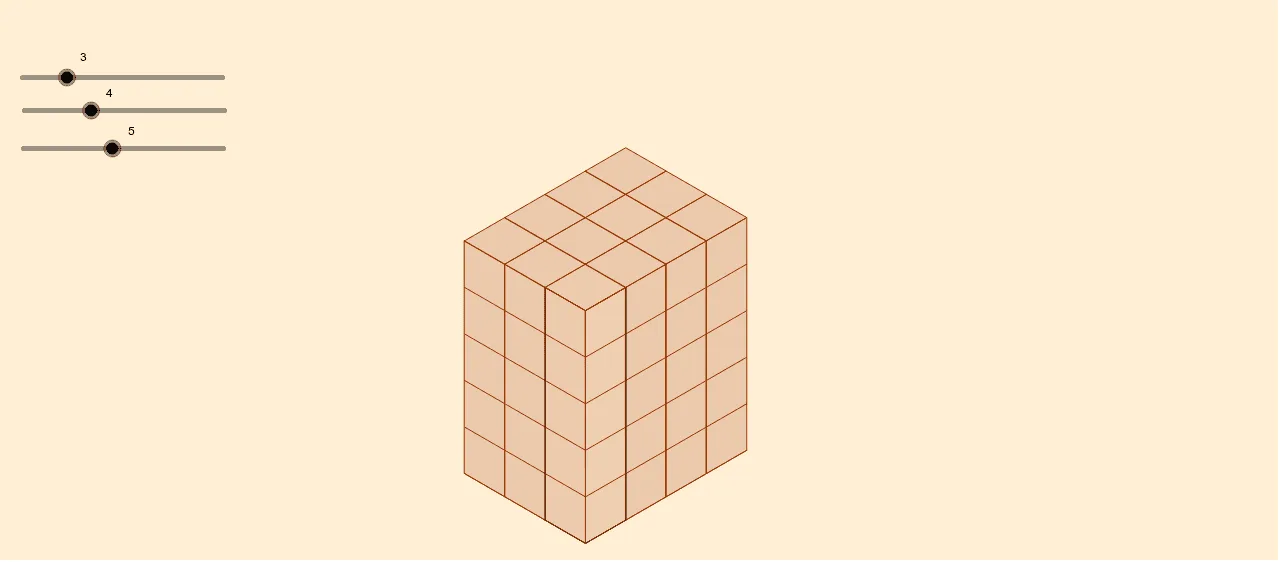
Loading the math board and drawing, please wait…
This example demonstrates how to build prisms made of unit cubes so students can understand volume by constructing a direct geometric model. As cube-based layers are assembled, the volume quantities naturally link to irrational-number relationships, making the idea of non-rational measure feel concrete rather than abstract. Key concepts include solid geometry and volume, the way length/area/volume correspond through squaring (and the resulting appearance of square roots or exponents), and precise geometric construction of 3D shapes from discrete units. Construction approach in GeoGebra: Intersect, Line, Segment, Point, and Polygon are used to define vertices, edges, and prism faces; Vector and Translate support copying and positioning layers in space; Sequence generates repeated elements to form the prism systematically; the resulting objects (including polygonal faces) align to ensure the cube stack and its derived volume remain accurate. Suitable for late middle school through high school, and for lessons on volume modeling, geometric constructions, and intuitive introduction to irrational numbers.
GeoGebra Commands & Parameters
Intersect(xAxis, yAxis) → HVector(H, I) → uSegment(D, C) → bSegment(C, F) → fSegment(D, G) → gSegment(G, F) → hSegment(F, E) → iLine(E, F) → jLine(H, j) → k_1Segment(E, B) → aSegment(B, C) → cPoint(yAxis) → AVector(H, A) → vVector(H, J) → wPolygon(B, C, F, E) → çokgen1, b_1, c_1, f_1, e_1Polygon(C, D, G, F) → çokgen2, c_2, d_1, g_1, f_2Polygon(B, K, D, C) → çokgen3, b_2, k_2, d, c_3Translate(B, u) → B'Translate(K, u) → K'Translate(D, u) → D'Translate(C, u) → C'Intersect(j, f) → LIntersect(g, h) → MLine(L, M) → qTranslate(B, w) → B'_1Translate(K, w) → K'_1Translate(D, w) → D'_1Translate(C, w) → C'_1Translate(B', w) → B''Translate(K', w) → K''Translate(D', w) → D''Translate(C', w) → C''Translate(B'', w) → B'''Translate(K'', w) → K'''Translate(D'', w) → D'''Translate(C'', w) → C'''Translate(B''', w) → NTranslate(K''', w) → OTranslate(D''', w) → PTranslate(C''', w) → QTranslate(N, w) → N'Translate(O, w) → O'Translate(P, w) → P'Translate(Q, w) → Q'Translate(B'', w) → B'''_1Translate(K'', w) → K'''_1Translate(D'', w) → D'''_1Translate(C'', w) → C'''_1Translate(B'''_1, w) → RTranslate(K'''_1, w) → STranslate(D'''_1, w) → TTranslate(C'''_1, w) → UTranslate(R, w) → R'Translate(S, w) → S'Translate(T, w) → T'Translate(U, w) → U'Intersect(j, q) → VIntersect(b, f) → WIntersect(b_2, k_2) → Z_1Intersect(b_2, k_2) → K_1Translate(C, w) → C'_2Translate(D, w) → D'_2Translate(G, w) → G'Translate(F, w) → F'Sequence(Polygon[Translate[B, Vector[(i * u)]], Translate[K, Vector[(i * u)]], Translate[D, Vector[(i * u)]], Translate[C, Vector[(i * u)]]], i, 1, k - 1) → liste3Sequence(Translate[Element[liste1, 1], Vector[(i * u)]], i, 1, k - 1) → liste4Sequence(Polygon[Translate[B, Vector[(i * u)]], Translate[C, Vector[(i * u)]], Translate[F, Vector[(i * u)]], Translate[E, Vector[(i * u)]]], i, 1, k - 1) → liste5Sequence(Segment[Translate[F, Vector[(u * i)]], Translate[E, Vector[(u * i)]]], i, 0, k - 1) → liste10Sequence(Translate[liste10, Vector[(v * i)]], i, 1, o - 1) → liste11Sequence(Segment[Translate[G, Vector[(w * i)]], Translate[F, Vector[(w * i)]]], i, 0, m - 1) → liste12Sequence(Translate[liste12, Vector[(v * i)]], i, 1, o - 1) → liste13
AI Drawing Prompt Reference
Create a 3D stack of unit cubes forming a prism to visualize irrational volume. Start with a single cube defined by its base polygon and vertical edges. Then replicate this cube along two distinct directions (representing two translation vectors) to build multiple layers, ensuring each layer aligns precisely. The final shape is a solid prism composed of discrete unit cubes, whose total volume relates to the square root of the side length, demonstrating non-rational measure.
The prompt above was compiled from the original drawing commands and is for reference only.