
Unit Cube and Volume Calculation Application
Loading the math board and drawing, please wait…
In collections
Quader und Würfel - Volumen
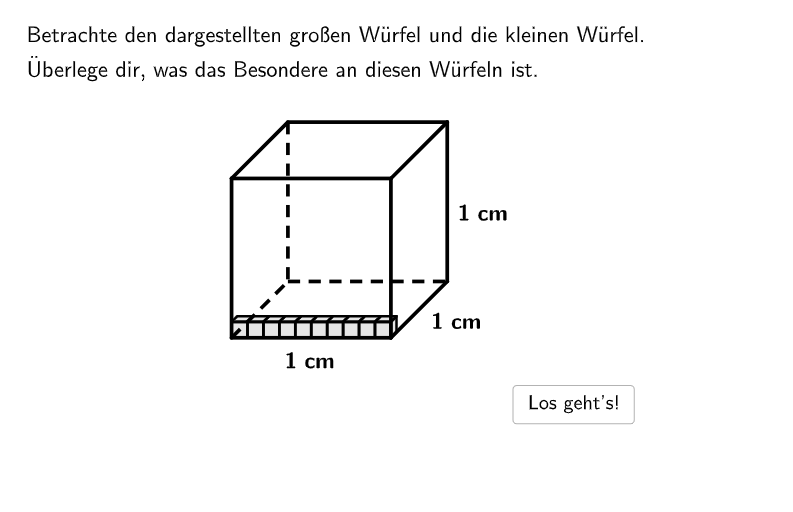
This GeoGebra example demonstrates the concept of a unit cube (edge length 1 decimeter) and its application in calculating rectangular prism volumes. Using GeoGebra commands including Rotate, Segment, Polygon, and Sequence, the model constructs 3D cube structures with interactive sliders for parameter adjustment. The key learning objective is showing how to derive the volume formula V=l×w×h by dividing a cuboid into unit cubes, with open-ended problems for students to calculate volumes of given dimensions. Suitable for grades 5-6 students learning about volume concepts and spatial geometry fundamentals.
GeoGebra Commands & Parameters
Rotate(B + ((sliderB_1 * verzerrung), 0), winkel, B) → CRotate(A + ((sliderB_1 * verzerrung), 0), winkel, A) → DRotate(F + ((sliderB_1 * verzerrung), 0), winkel, F) → GRotate(E + ((sliderB_1 * verzerrung), 0), winkel, E) → HSegment(A, B) → fSegment(A, E) → gSegment(F, B) → hSegment(E, F) → iSegment(B, C) → jSegment(A, D) → kSegment(D, C) → lSegment(C, G) → mSegment(G, H) → nSegment(H, D) → pSegment(E, H) → qSegment(F, G) → rTextfield(aInput) → InputBox1Polygon(A, B, C, G, H, E) → poly1, a, b, c, g_1, h_1, eSequence(Sequence[Polygon[A + (i, cubesVertical - 0.7) + ((j * cubeDepthCathetersWuerfel / 10), (j * cubeDepthCathetersWuerfel / 10)), A + (i, cubesVertical - 0.7) + ((j * cubeDepthCathetersWuerfel / 10), (j * cubeDepthCathetersWuerfel / 10)) + (cubeLengthWuerfel / 10, 0), A + (i, cubesVertical - 0.7) + ((j * cubeDepthCathetersWuerfel / 10), (j * cubeDepthCathetersWuerfel / 10)) + (cubeLengthWuerfel / 10 + cubeDepthCathetersWuerfel / 10, cubeDepthCathetersWuerfel / 10), A + (i, cubesVertical - 0.7) + ((j * cubeDepthCathetersWuerfel / 10), (j * cubeDepthCathetersWuerfel / 10)) + (cubeDepthCathetersWuerfel / 10, cubeDepthCathetersWuerfel / 10)], i, 0, cubesHorizontal - 1, 0.3], j, 0, cubesDepth - 1, 0.3) → cubesAD, {{0.03181980515339422, 0.031819805153394665, 0.031819805153394665, 0.03181980515339422, 0.03181980515339333, 0.03181980515339333, 0.03181980515339422, 0.03181980515339422, 0.031819805153396, 0.031819805153396}}Sequence(Sequence[Polygon[A + (i, j), A + (i, j) + (cubeLengthWuerfel / 10, 0), A + (i, j) + (cubeLengthWuerfel / 10, cubeLengthWuerfel / 10), A + (i, j) + (0, cubeLengthWuerfel / 10)], i, 0, cubesHorizontal - 1, 0.3], j, 0, cubesVertical - 1, 0.3) → cubesAB, {{0.08999999999999986, 0.08999999999999986, 0.08999999999999986, 0.08999999999999986, 0.08999999999999986, 0.08999999999999986, 0.08999999999999986, 0.08999999999999986, 0.08999999999999986, 0.08999999999999808}}Sequence(Sequence[Polygon[A + (cubesHorizontal - 0.9, j) + ((i * cubeDepthCathetersWuerfel / 10), (i * cubeDepthCathetersWuerfel / 10)), A + (cubesHorizontal - 0.9, j) + ((i * cubeDepthCathetersWuerfel / 10), (i * cubeDepthCathetersWuerfel / 10)) + (cubeDepthCathetersWuerfel / 10, cubeDepthCathetersWuerfel / 10), A + (cubesHorizontal - 0.9, j) + ((i * cubeDepthCathetersWuerfel / 10), (i * cubeDepthCathetersWuerfel / 10)) + (cubeDepthCathetersWuerfel / 10, cubeDepthCathetersWuerfel / 10 + cubeLengthWuerfel / 10), A + (cubesHorizontal - 0.9, j) + ((i * cubeDepthCathetersWuerfel / 10), (i * cubeDepthCathetersWuerfel / 10)) + (0, cubeLengthWuerfel / 10)], i, 0, cubesDepth - 1, 0.3], j, 0, cubesVertical - 1, 0.3) → cubesBF, {{0.03181980515339333}}Segment(A_1, B_1) → abSegment(A_1, D_1) → adSegment(A_1, E_1) → aeSegment(B_1, F_1) → bfSegment(B_1, C_1) → bcSegment(C_1, D_1) → cdSegment(C_1, G_1) → cgSegment(D_1, H_1) → dhSegment(E_1, F_1) → efSegment(E_1, H_1) → ehSegment(F_1, G_1) → fgSegment(G_1, H_1) → ghSequence(Sequence[Polygon[A_1 + (i, j), A_1 + (i, j) + (cubeLengthWuerfel_1 / 10, 0), A_1 + (i, j) + (cubeLengthWuerfel_1 / 10, cubeLengthWuerfel_1 / 10), A_1 + (i, j) + (0, cubeLengthWuerfel_1 / 10)], i, 0, cubesHorizontal_1 - 1], j, 0, cubesVertical_1 - 1) → cubesAB_1, {{1}}Sequence(Sequence[Polygon[A_1 + (i, cubesVertical_1) + ((j * cubeDepthCathetersWuerfel_1 / 10), (j * cubeDepthCathetersWuerfel_1 / 10)), A_1 + (i, cubesVertical_1) + ((j * cubeDepthCathetersWuerfel_1 / 10), (j * cubeDepthCathetersWuerfel_1 / 10)) + (cubeLengthWuerfel_1 / 10, 0), A_1 + (i, cubesVertical_1) + ((j * cubeDepthCathetersWuerfel_1 / 10), (j * cubeDepthCathetersWuerfel_1 / 10)) + (cubeLengthWuerfel_1 / 10 + cubeDepthCathetersWuerfel_1 / 10, cubeDepthCathetersWuerfel_1 / 10), A_1 + (i, cubesVertical_1) + ((j * cubeDepthCathetersWuerfel_1 / 10), (j * cubeDepthCathetersWuerfel_1 / 10)) + (cubeDepthCathetersWuerfel_1 / 10, cubeDepthCathetersWuerfel_1 / 10)], i, 0, cubesHorizontal_1 - 1], j, 0, cubesDepth_1 - 1) → cubesAD_1, {{0.35355339059327484}}Sequence(Sequence[Polygon[A_1 + (cubesHorizontal_1, j) + ((i * cubeDepthCathetersWuerfel_1 / 10), (i * cubeDepthCathetersWuerfel_1 / 10)), A_1 + (cubesHorizontal_1, j) + ((i * cubeDepthCathetersWuerfel_1 / 10), (i * cubeDepthCathetersWuerfel_1 / 10)) + (cubeDepthCathetersWuerfel_1 / 10, cubeDepthCathetersWuerfel_1 / 10), A_1 + (cubesHorizontal_1, j) + ((i * cubeDepthCathetersWuerfel_1 / 10), (i * cubeDepthCathetersWuerfel_1 / 10)) + (cubeDepthCathetersWuerfel_1 / 10, cubeDepthCathetersWuerfel_1 / 10 + cubeLengthWuerfel_1 / 10), A_1 + (cubesHorizontal_1, j) + ((i * cubeDepthCathetersWuerfel_1 / 10), (i * cubeDepthCathetersWuerfel_1 / 10)) + (0, cubeLengthWuerfel_1 / 10)], i, 0, cubesDepth_1 - 1], j, 0, cubesVertical_1 - 1) → cubesBF_1, {{0.35355339059327484}}
AI Drawing Prompt Reference
Draw a unit cube with edge length 1 decimeter and demonstrate how to calculate the volume of a rectangular prism by dividing it into unit cubes. Use rotation and segment tools to construct 3D cube structures, and add sliders for parameter adjustment. Show how to derive the volume formula V=l×w×h by dividing the cuboid into unit cubes, and provide open-ended problems for students to calculate volumes of given dimensions.
The prompt above was compiled from the original drawing commands and is for reference only.