
Unit Circle Trace Demo
Loading the math board and drawing, please wait…
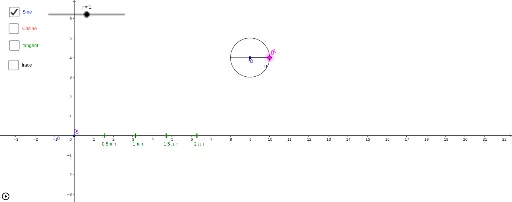
This example demonstrates the locus of points on a unit circle and its related geometric properties. It involves core mathematical concepts such as the unit circle, trigonometric functions, locus, and analytical geometry. The construction utilizes GeoGebra commands and objects like Mirror, Segment, Circle, Point, OrthogonalLine, Intersect, Angle, CircleArc, Length, Sequence, Translate, Rotate, Line, and If. It is suitable for high school mathematics teaching, helping students understand the relationship between trigonometric functions, geometric shapes, and locus problems.
GeoGebra Commands & Parameters
Mirror(A_0, O) → E_0Segment(E_0, A_0) → bCircle(O, A_0) → circPoint(circ) → AOrthogonalLine(A, b) → aSegment(O, A) → hypIntersect(a, b) → BSegment(B, A) → sAngle(A_0, O, A) → αSegment(O, B) → cSegment(C, CS_0) → ccCircleArc(O, A_0, A) → dSegment(C_1, C) → ddLength(d) → lendPoint(d) → DSegment(S_1, S) → eSegment(CS_0, S) → fAngle(O, B, A) → βSequence((((i * r) * π / 2), 0), i, 1, 4) → grad1Segment(B, A) → iTranslate(Segment[O, Rotate[B, (p * π / 2), O]], Vector[(p * Vector[O, CS_0])]) → jRotate(A_0, (α * hyp / Distance[A_0, H]), H) → A'CircleArc(H, A_0, A') → kTranslate(Rotate[k, (p * π / 2), A'], Vector[(p * Vector[A', C_1])]) → qTranslate(B, Vector[(p * Vector[A, S])]) → B'Translate(A, Vector[(p * Vector[A, S])]) → A'_1Segment(B', A'_1) → s'Translate(Rotate[k, (p * π / 2), A'], Vector[(p * Vector[A', S_1])]) → t_1OrthogonalLine(A_0, b) → lLine(O, A) → nIntersect(l, n) → T_1If(Defined[T_1], A_0, E_0) → ESegment(T, (x(T), 0)) → ttSegment(T, (0, y(T))) → a_1Translate(Rotate[k, (p * π / 2), A'], Vector[(p * Vector[A', (0, y(T))])]) → c_1Segment(A_0, T_1) → tTranslate(A_0, Vector[(p * Vector[T_1, T])]) → FTranslate(T_1, Vector[(p * Vector[T_1, T])]) → GSegment(F, G) → t'Angle(T_1, E, B) → γSequence(Text[" " + (i / 2) + " π r", (((i * r) * π / 2) - 0.2, -0.5)], i, 1, 4) → grad2