
Unit Circle Sine Demonstration by Michael O'Connor
Loading the math board and drawing, please wait…
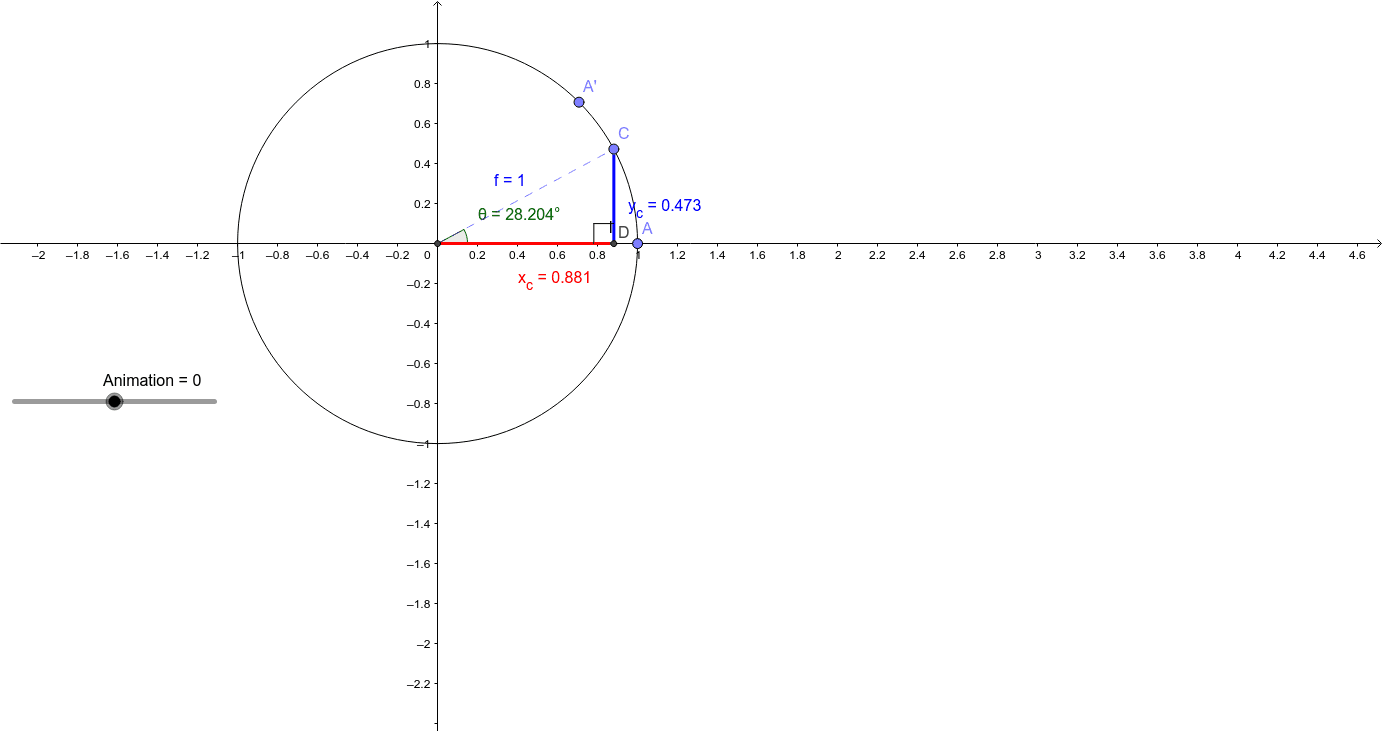
This example dynamically illustrates the relationship between the position of a point on the unit circle and its corresponding sine value, visually demonstrating the definition and graph of the sine function. Core mathematical concepts include the unit circle, trigonometric functions, coordinate geometry, and the correspondence between angles and sine values. Construction highlights involve GeoGebra commands/objects like Point, Intersect, Circle, Angle, Segment, OrthogonalLine, Circumference, PointIn, Rotate, with key elements such as points A, B, intersection, angle θ measurement, and orthogonal line drawing. Suitable for high school students to understand the sine function definition or as an introductory aid for analytical geometry.
GeoGebra Commands & Parameters
Point(xAxis) → AIntersect(xAxis, yAxis) → BCircle(B, A) → cPoint(c) → CAngle(A, B, C) → θSegment(B, C) → fOrthogonalLine(C, xAxis) → gIntersect(g, xAxis) → DSegment(C, D) → y_cCircumference(c) → circumferencecPointIn(c) → PointcSegment(B, D) → x_cCircle(D, 0.1) → dIntersect(d, x_c, 1) → EIntersect(d, y_c, 1) → FOrthogonalLine(E, xAxis) → jOrthogonalLine(F, j) → kIntersect(j, k) → GSegment(E, G) → lSegment(G, F) → mRotate(A, 45°, B) → A'