
Unit Circle (Quadrant Identities)
Loading the math board and drawing, please wait…
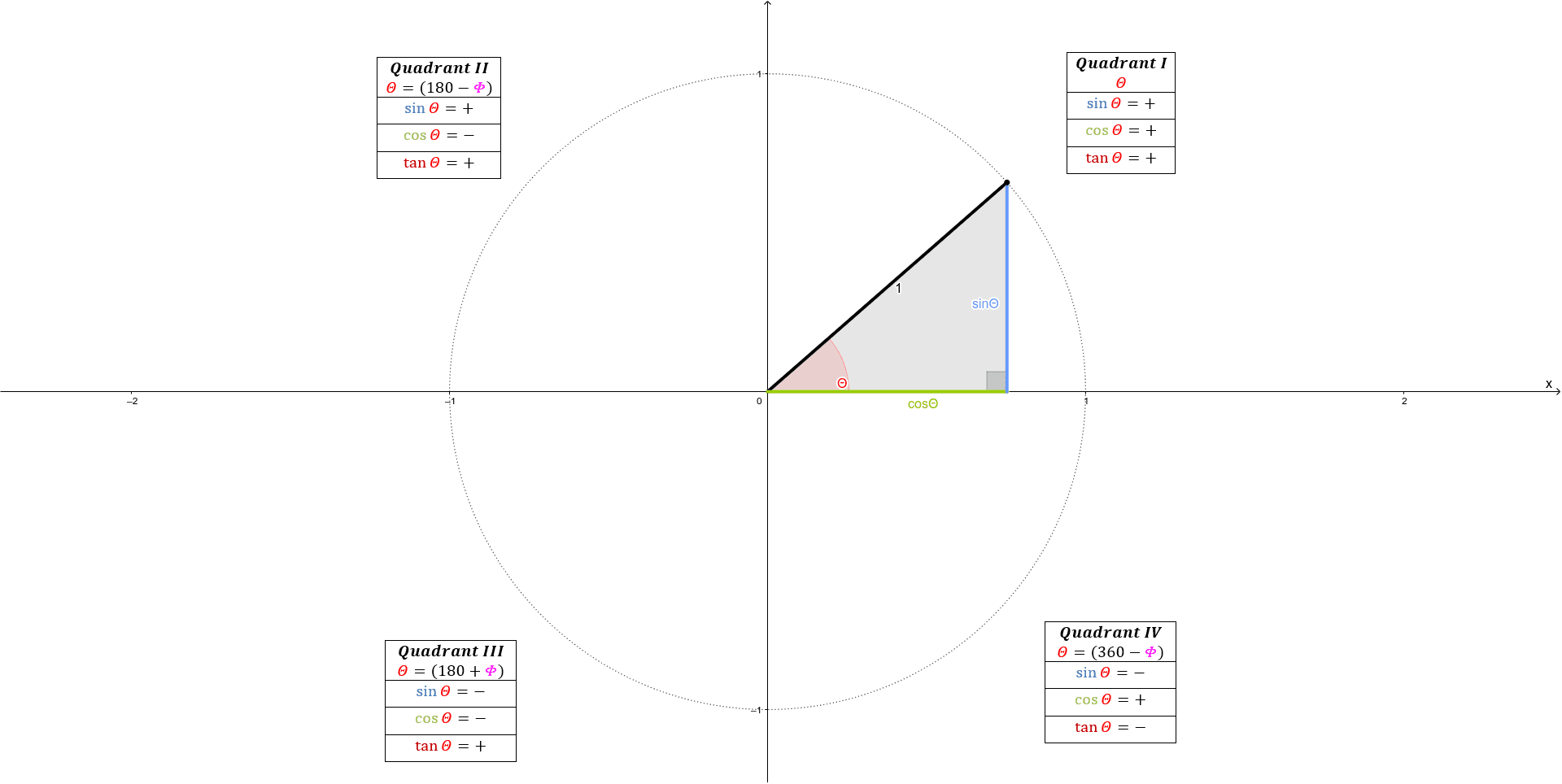
This example demonstrates quadrant identities on the unit circle. Key mathematical concepts include trigonometry and the unit circle. Using GeoGebra commands such as Intersect, Circle, and Point, the construction of points on the unit circle and related quadrant angles is illustrated. Suitable for high school mathematics education and learning trigonometry.
GeoGebra Commands & Parameters
Intersect(xAxis, yAxis) → ACircle(A, B) → cPoint(c) → CPoint(Circle[A, 1]) → DSegment(A, C) → fOrthogonalLine(C, f) → gIntersect(g, xAxis) → EIntersect(g, yAxis) → FOrthogonalLine(C, xAxis) → jIntersect(j, xAxis) → GOrthogonalLine(C, yAxis) → kIntersect(k, yAxis) → HSegment(A, H) → lSegment(A, G) → mSegment(C, G) → qSegment(C, H) → rAngle(C, G, A) → βAngle(B, A, C) → ΘIntersect(m, q) → JPolygon(C, J, A) → poly1, a, c_1, j_1Ray(A, C) → iPoint(yAxis) → IPoint(xAxis) → KSegment(I, K) → hOrthogonalLine(K, h) → nOrthogonalLine(I, h) → pIntersect(p, xAxis) → LOrthogonalLine(L, p) → sIntersect(n, s) → MSegment(I, L) → tSegment(L, M) → bSegment(M, K) → dIntersect(i, t) → NIntersect(i, b) → OIntersect(i, d) → PAngle(N, A, L) → αAngle(L, A, O) → γOrthogonalLine(N, yAxis) → eIntersect(e, h) → QSegment(A, Q) → f_1Intersect(c, f_1, 1) → RAngle(K, A, R) → δOrthogonalLine(R, xAxis) → g_1Intersect(g_1, xAxis) → SSegment(A, R) → h_1Segment(R, S) → i_1Segment(S, A) → k_1Ray(O, A) → l_1Intersect(c, l_1, 2) → TOrthogonalLine(T, xAxis) → m_1Intersect(m_1, xAxis) → USegment(A, T) → n_1Segment(T, U) → p_1Segment(U, A) → q_1Angle(U, A, T) → εOrthogonalLine(P, xAxis) → r_1Intersect(r_1, h) → VSegment(A, V) → s_1Intersect(c, s_1, 1) → WSegment(A, W) → t_1Segment(W, J) → a_1Angle(K, A, W) → ζAngle(P, A, K) → ηIntersect(i, b) → H_1Intersect(i, t) → I_1Intersect(i, h) → J_1