
Unit Circle Investigation 2
Loading the math board and drawing, please wait…
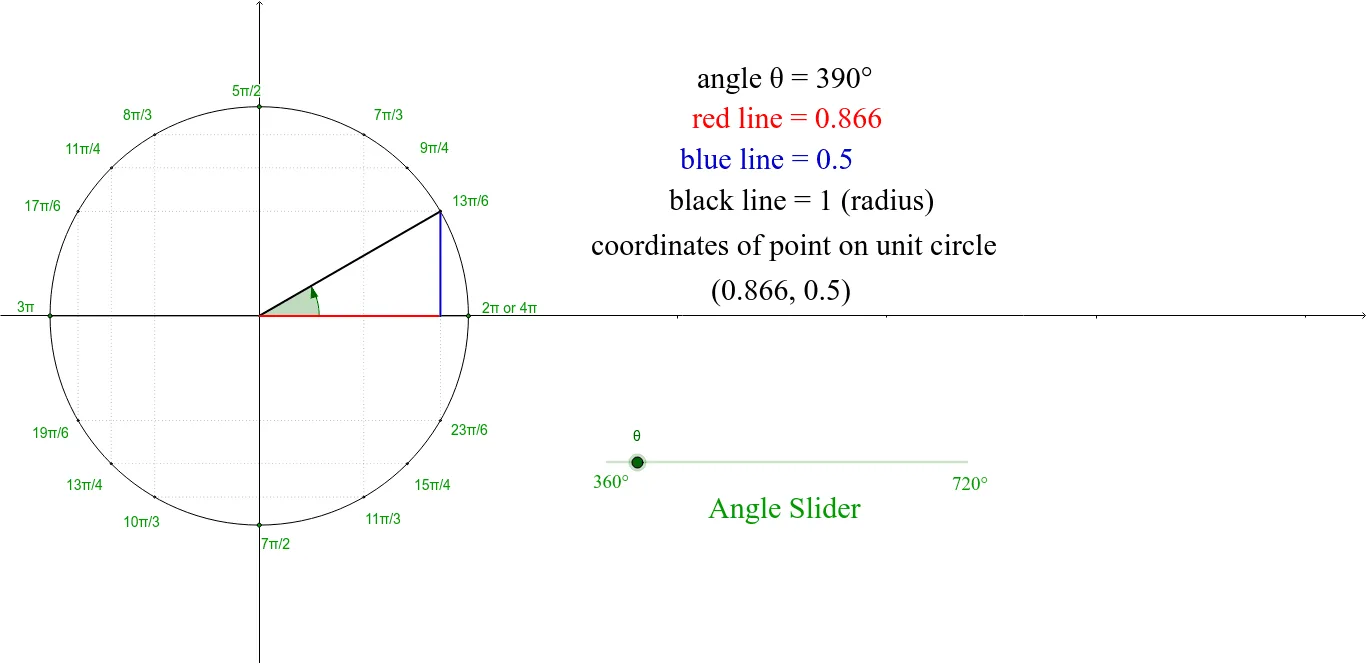
This example demonstrates the interaction between the unit circle and concepts such as linear regression, step functions, conditional probability, surfaces, and binomial distribution. It involves core mathematical concepts including the unit circle, linear regression, step functions, conditional probability, surfaces, and binomial distribution. The construction uses GeoGebra commands like Intersect, Circle, Segment, Point, Rotate, Angle, and OrthogonalLine. Suitable for high school students and mathematicians/researchers.
GeoGebra Commands & Parameters
Intersect(xAxis, yAxis) → ACircle(A, 1) → cIntersect(c, xAxis, 1) → π1Intersect(c, xAxis, 2) → zeroSegment(π1, zero) → aIntersect(c, yAxis, 2) → π2Intersect(c, yAxis, 1) → π3_2Segment(π2, π3_2) → bPoint(c) → π6Rotate(zero, θ, A) → D'Angle(zero, A, D') → αSegment(A, D') → iOrthogonalLine(D', a) → jOrthogonalLine(D', b) → kIntersect(j, a) → QSegment(A, Q) → lSegment(D', Q) → mIntersect(c, i, 1) → pointPoint(c) → π3Point(c) → π4Point(c) → π2_3Point(c) → π3_4Point(c) → π5_6Point(c) → π7_6Point(c) → π5_4Point(c) → π4_3Point(c) → π5_3Point(c) → π7_4Point(c) → π11_6Segment(π2_3, π3) → nSegment(π3_4, π4) → pSegment(π5_6, π6) → qSegment(π7_6, π11_6) → rSegment(π5_4, π7_4) → sSegment(π4_3, π5_3) → tSegment(π6, π11_6) → a_1Segment(π3, π5_3) → c_1Segment(π2_3, π4_3) → d_1Segment(π3_4, π5_4) → e_1Segment(π5_6, π7_6) → f_1