
Types of Brackets in Inequalities — GeoGebra Construction Example
Loading the math board and drawing, please wait…
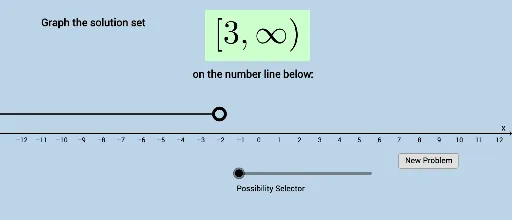
This example demonstrates how to represent and manipulate different types of brackets in inequalities within GeoGebra, helping students visually understand the relationship between interval notation and inequality solution sets. Core mathematical concepts include inequalities, interval notation, bracket types (round vs. square parentheses), and the determination of open versus closed boundary points. Construction highlights: Segment and Ray commands are used to build the number line and interval representations; Random commands generate test points; multiple point objects (e.g., A, B, C, D, E, F) mark endpoints and key positions; text objects annotate inequality expressions and interval descriptions. This example is suitable for middle to high school algebra instruction, particularly for teaching linear inequalities, representing solution sets on a number line, and standard interval notation. It works well as classroom demonstration material or for student self-exploration.
GeoGebra Commands & Parameters
Segment(A, B) → gSegment((x(A) + 0.3, 1), (x(B) - 0.3, 1)) → jRay((x(A) - 0.3, 1), (x(D), y(D))) → iRay((x(B) + 0.3, 1), (x(C), y(C))) → hRay((x(A) + 0.3, 1), (x(C), y(C))) → kRandom(-10, 9) → aaRandom(aa + 1, 10) → bbRandom(1, 8) → nn