
Two Reflections by Roy Wright
Loading the math board and drawing, please wait…
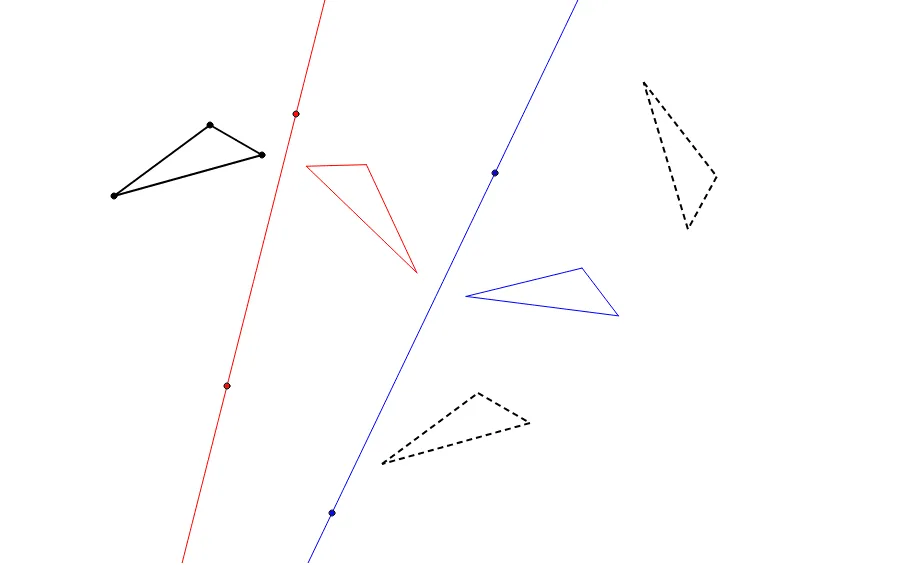
This example demonstrates how two consecutive line reflections can be used to create any desired translation and/or rotation. It involves core math concepts like reflection, rotation, translation, vector, and geometric construction. Constructed using GeoGebra commands: Segment, Line, Mirror. Suitable for high school geometry transformation teaching, math competitions, and geometric exploration activities.
GeoGebra Commands & Parameters
Segment(A, B) → aSegment(B, C) → bSegment(C, A) → cLine(D, E) → dLine(F, G) → eLine(H, I) → fMirror(B, d) → B'Mirror(C, d) → C'Segment(B', C') → b'Mirror(A, d) → A'Mirror(B, d) → B'_1Segment(A', B'_1) → a'Mirror(C, d) → C'_1Mirror(A, d) → A'_1Segment(C'_1, A'_1) → c'Mirror(B', e) → B''Mirror(C', e) → C''Segment(B'', C'') → b''Mirror(C'_1, e) → JMirror(A'_1, e) → KSegment(J, K) → c''Mirror(A', e) → A''Mirror(B'_1, e) → LSegment(A'', L) → a''Mirror(J, f) → J'Mirror(K, f) → K'Segment(J', K') → c'''Mirror(A'', f) → A'''Mirror(L, f) → L'Segment(A''', L') → a'''Mirror(B'', f) → B'''Mirror(C'', f) → C'''Segment(B''', C''') → b'''Segment(A_2, B_2) → a_2Segment(B_2, C_2) → b_2Segment(C_2, A_2) → c_2Segment(A_3, B_3) → a_3Segment(B_3, C_3) → b_3Segment(C_3, A_3) → c_3Line(N, O) → gLine(O, P) → hMirror(A, g) → A'_2Mirror(B, g) → B'_2Segment(A'_2, B'_2) → a'_1Mirror(B, g) → B'_3Mirror(C, g) → C'_2Segment(B'_3, C'_2) → b'_1Mirror(C, g) → C'_3Mirror(A, g) → A'_3Segment(C'_3, A'_3) → c'_1Mirror(A'_2, h) → QMirror(B'_2, h) → RSegment(Q, R) → iMirror(B'_3, h) → SMirror(C'_2, h) → TSegment(S, T) → jMirror(C'_3, h) → UMirror(A'_3, h) → VSegment(U, V) → kLine(M, W) → lLine(Z, l) → mMirror(A, l) → A'_4Mirror(B, l) → B'_4Segment(A'_4, B'_4) → a'_2Mirror(B, l) → B'_5Mirror(C, l) → C'_4Segment(B'_5, C'_4) → b'_2Mirror(C, l) → C'_5Mirror(A, l) → A'_5Segment(C'_5, A'_5) → c'_2Mirror(A'_4, m) → D_1Mirror(B'_4, m) → E_1Segment(D_1, E_1) → nMirror(B'_5, m) → F_1Mirror(C'_4, m) → G_1Segment(F_1, G_1) → pMirror(C'_5, m) → H_1Mirror(A'_5, m) → I_1Segment(H_1, I_1) → q
AI Drawing Prompt Reference
Draw a triangle and three lines. Reflect the two sides of the triangle successively with the first line to get two new points, and connect them to form a new line segment. Reflect all vertices of the triangle with the first line to get three new points, and connect them to form three new line segments. Then reflect the two new line segments with the second line to get two new sets of points, and connect them to form four new line segments. Finally, reflect the four new line segments with the third line to get two new sets of points, and connect them to form eight new line segments.
The prompt above was compiled from the original drawing commands and is for reference only.