
Two Lines Cut by a Transversal
Loading the math board and drawing, please wait…
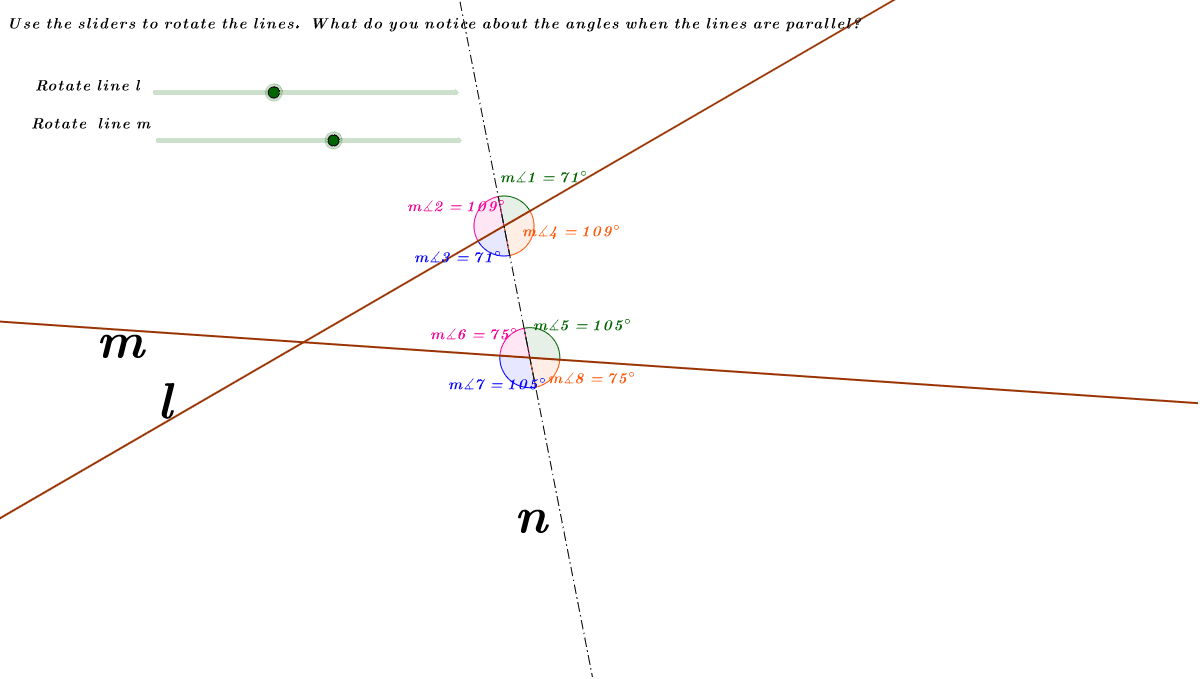
This example demonstrates the geometric relationships and angle properties formed when two lines are intersected by a transversal. Key math concepts include properties of parallel lines, corresponding angles, alternate interior angles, and consecutive interior angles. The construction utilizes GeoGebra commands and objects such as Rotate, Angle, Line, Point, Intersect, and Midpoint. Suitable for middle school and high school students learning geometric theorems and proofs, as well as high school analytical geometry instruction.
GeoGebra Commands & Parameters
Rotate(A, (-α), B) → CAngle(C, B, A) → βLine(B, C) → aLine(A, B) → bPoint(b) → DRotate(B, (-γ), D) → EAngle(E, D, B) → δLine(D, E) → cPoint(a) → FPoint(c) → GAngle(A, B, F) → εAngle(F, B, D) → ζAngle(D, B, C) → ηPoint(b) → HAngle(B, D, G) → θAngle(G, D, H) → ιAngle(H, D, E) → κPoint(a) → IPoint(c) → JPoint(b) → KPoint(b) → LIntersect(β, a, 1) → PPoint(a) → QMidpoint(L, Q) → MIntersect(ε, a, 1) → NPoint(a) → OIntersect(ζ, b, 1) → SIntersect(η, b, 1) → TIntersect(ζ, b, 1) → UIntersect(ζ, b, 1) → VIntersect(ζ, b, 1) → WIntersect(ζ, b, 1) → ZIntersect(ζ, b, 1) → A_1Intersect(ζ, b, 1) → B_1Point(b) → RPoint(b) → C_1Point(c) → D_1Point(b) → E_1Point(c) → F_1Midpoint(L, O) → G_1Midpoint(O, R) → H_1Midpoint(R, Q) → I_1Midpoint(C_1, F_1) → J_1Midpoint(F_1, E_1) → K_1Midpoint(E_1, D_1) → L_1Midpoint(D_1, C_1) → M_1