
Two-Digit Subtraction with Visual Borrowing
Loading the math board and drawing, please wait…
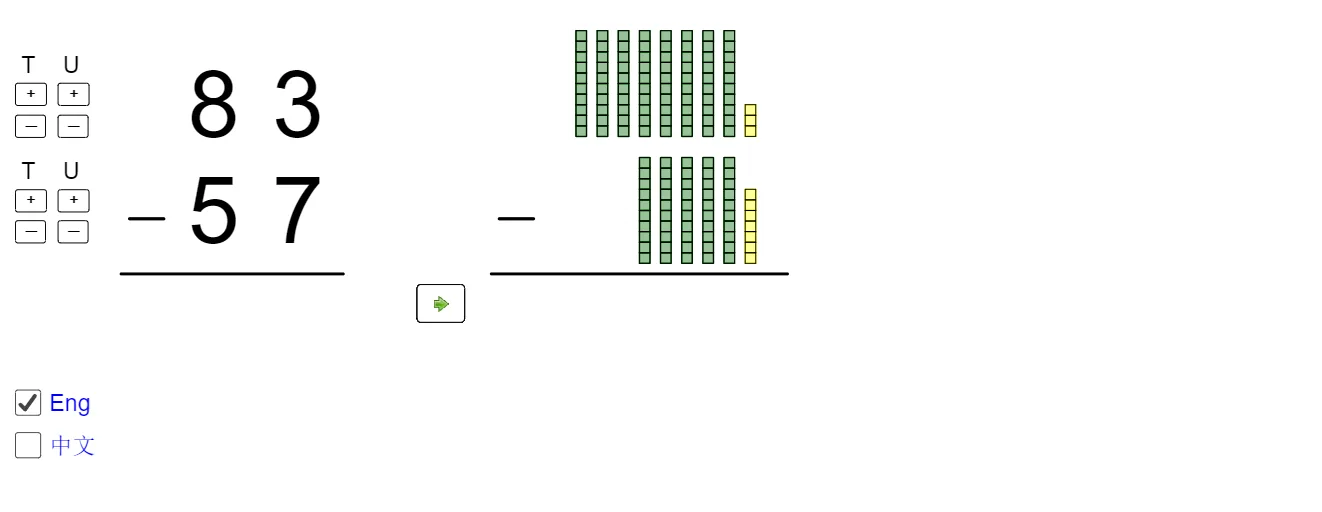
① This GeoGebra example demonstrates two-digit subtraction in a vertical (column) format, allowing users to input a minuend and subtrahend and observe the step-by-step borrowing process. ② The core mathematical concepts are integer subtraction, place value (tens and ones), and the borrowing (regrouping) algorithm. ③ Construction highlights: it uses Textfield and button objects for user input, Div and Mod commands to split numbers into tens and ones, If conditions to detect borrowing, and Segment, Sequence, Corner to draw the vertical layout and dynamic arrows. Key objects include mtens, nunits, diff, atens, and various text labels. ④ Suitable for early elementary students (grades 1-3) as an interactive practice tool, and for teachers to demonstrate subtraction algorithms in class.
GeoGebra Commands & Parameters
Div(diff, 10) → atensSegment(A, B) → fIf(nunits > munits, mtens - 1, mtens) → ntensmaxIf(ntens ≟ mtens, munits - 1, 9) → nunitsmaxSequence(Polygon[{C' + (0, i), C' + (1, i), C' + (1, i + 1), C' + (0, i + 1)}], i, 0, munits - 1) → L_1Sequence(Polygon[{D + (0, i), D + (1, i), D + (1, i + 1), D + (0, i + 1)}], i, 0, nunits - 1) → L_3Sequence(Sequence[Polygon[{D + (((-(1 + d)) * j), i), D + (1 - ((1 + d) * j), i), D + (1 - ((1 + d) * j), i + 1), D + (((-(1 + d)) * j), i + 1)}], i, 0, 9], j, 1, ntens) → L_4If(nunits > munits, C' + (-2, 10), C' + (0, munits)) → C0If((t2 * nunits) ≤ munits, (0, 0), (-2, 10 - munits)) → C1Segment(E, F) → gSequence(Sequence[Polygon[{C' + (((-(1 + d)) * j), i), C' + (1 - ((1 + d) * j), i), C' + (1 - ((1 + d) * j), i + 1), C' + (((-(1 + d)) * j), i + 1)}], i, 0, 9], j, 2, mtens) → L_2Sequence(Polygon[{C' + ((-(1 + d)), i), C' + (1 - (1 + d), i), C' + (1 - (1 + d), i + 1), C' + ((-(1 + d)), i + 1)}], i, 0, 9) → L_7Sequence(Segment[D0 + (-0.2, (-j) - 0.2), D0 + (1.2, (-(j - 1)) + 0.2)], j, 1, (t2 * nunits)) → L_5Corner(text1, 1) → GCorner(text1, 3) → HSegment(G + (0, (y(H) - y(G)) / 4), H + (0, (y(G) - y(H)) / 6)) → hSegment(I - (0.02, 0.2), I + (1.02, 10.2)) → iSegment(J - (0.02, 0.2), J + (1.02, 10.2)) → jMod(diff, 10) → aunitsSequence(Polygon[{C2 + (0, i), C2 + (1, i), C2 + (1, i + 1), C2 + (0, i + 1)}], i, 0, If[nunits > munits, 10 - nunits - 1, munits - nunits - 1]) → L_{10}Sequence(Sequence[Polygon[{C2' + (((-(1 + d)) * j), i), C2' + (1 - ((1 + d) * j), i), C2' + (1 - ((1 + d) * j), i + 1), C2' + (((-(1 + d)) * j), i + 1)}], i, 0, 9], j, 1, atens) → L_{12}Textfield(ansunits) → InputBox1Textfield(anstens) → InputBox2Corner(text2, 1) → LCorner(text2, 3) → MSegment(L + (0, (y(M) - y(L)) / 4), M + (0, (y(L) - y(M)) / 6)) → kIf(ansunits ≟ "", true, false) → notinput1If(ansunits ≟ aunits', true, false) → correct1If(anstens ≟ "", true, false) → notinput2If(anstens ≟ atens', true, false) → correct2If(nunits > munits, 1, 0) → s1If(nunits > 0, 1, 0) → s2If(aunits > 0, 1, 0) → s3If(ntens > 0, 1, 0) → s4If(atens > 0, 1, 0) → s5If(t1 + t2 + t3 + t4 + t5 ≟ s1 + s2 + s3 + s4 + s5, true, false) → finishedSequence(Translate[j, Vector[(k * Vector[(-2, 0)])]], k, 0, (t4 * ntens) - 1) → L_9Sequence(Translate[i, Vector[(j * Vector[(-2, 0)])]], j, 0, (t4 * ntens) - 1) → L_8Sequence(Segment[C0 + (-0.2, (-j) - 0.2), C0 + (1.2, (-(j - 1)) + 0.2)], j, 1, (t2 * nunits)) → L_6Sequence(Polygon[{C3' + (0, i), C3' + (1, i), C3' + (1, i + 1), C3' + (0, i + 1)}], i, 0, munits - 1) → L_{14}
AI Drawing Prompt Reference
Create a vertical two-digit subtraction diagram with visual borrowing. Show the minuend and subtrahend at top, difference below. Represent tens and ones with colored square blocks. When ones are insufficient, illustrate borrowing by crossing out a ten-block and adding ten ones, with arrows or slashes. Include two input boxes for answers and check marks for correctness. Arrange blocks and digits in aligned columns for clear place-value understanding.
The prompt above was compiled from the original drawing commands and is for reference only.