
Truncated Biscribed Pentakis: Dependence of Vertex Average Distance on Truncatio
Loading the math board and drawing, please wait…
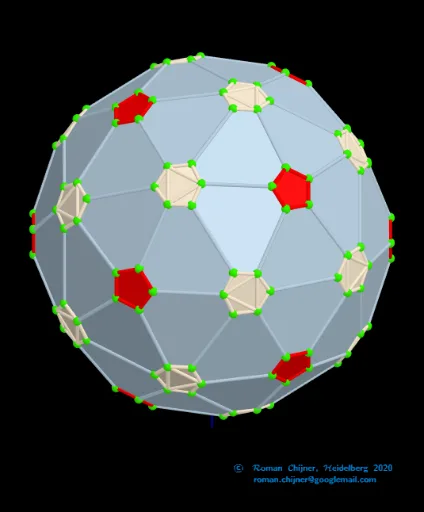
This example demonstrates the dependence of the average distance between vertices of a truncated biscribed pentakis polyhedron on the truncation parameter, along with extreme distributions. Key mathematical concepts include solid geometry, parametric equations, and optimization. The construction utilizes GeoGebra commands and objects such as Join, Unique, Length, Sphere, Ray, Zip, UnicodeToLetter, TableText, KeepIf, Text, and Sum to visualize how parameter changes affect the geometric shape. Suitable for high school students and math enthusiasts exploring complex polyhedra and optimization problems.
GeoGebra Commands & Parameters
Join(Zip[lP0(x(a)) + ((lP0(y(a)) - lP0(x(a))) * {t, 1 - t}), a, segN]) → lVVUnique(lVV) → lP'Length(lP') → nLength(lVV(1)) → R2Sphere(O, R1) → sp1Sphere(O, R2) → sp2Ray(B, AA) → hZip(Segment[lP0(x(a)), lP0(y(a))], a, segN1) → seg1Zip(Segment[lP0(x(a)), lP0(y(a))], a, segN2) → seg2Zip(Polygon[a], a, v_poly03) → poly03Zip(Polygon[a], a, v_poly06) → poly06Zip(Polygon[a], a, v_poly05) → poly05UnicodeToLetter(34) → u34Zip(Segment[lVV(x(a)), lVV(y(a))], a, segNΔ5) → segΔ5Zip(Segment[lVV(x(a)), lVV(y(a))], a, segNΔ6) → segΔ6Zip(Segment[lVV(x(a)), lVV(y(a))], a, segNΔ31) → segΔ31Zip(Segment[lVV(x(a)), lVV(y(a))], a, segNΔ32) → segΔ32TableText(Append["\;\;\; \fgcolor{#CD7F32}{3_1-gons}", segΔ31], Append["\;\;\; \fgcolor{#CD7F32}{3_2-gons}", segΔ32], Append["\;\;\; \fgcolor{red}{5-gons}", segΔ5], Append["\;\;\; \fgcolor{#6E7F80}{6-gons}", segΔ6], "v") → text3aUnique(round(poly03, 14)) → poly03roundKeepIf(a ≟ poly03round(1), a, poly03) → poly03_2KeepIf(a ≟ poly03round(2), a, poly03) → poly03_1Text("" + p3) → txt_pSum(Flatten[Sequence[Append[Sequence[Element[txt_p, i], i, m1(k), m2(k)], " "], k, 1, 5]]) → txtUm1Text(text12, C, false, true) → text8