
Trigonometric Ratios by Bruce
Loading the math board and drawing, please wait…
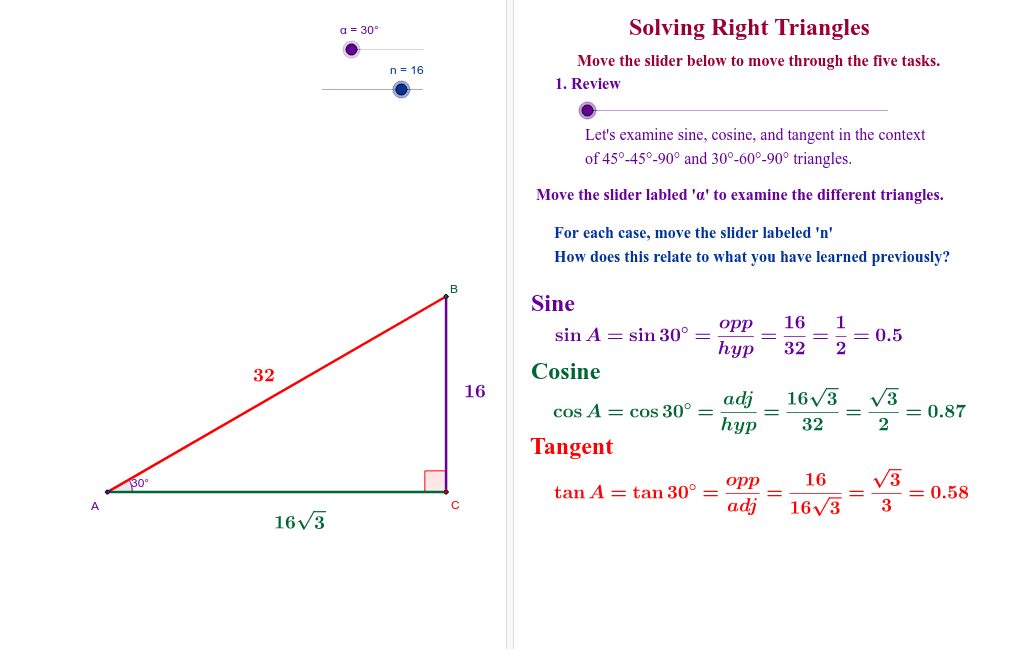
This example demonstrates the concept of trigonometric ratios. By constructing angles and triangles, it illustrates the definitions of basic trigonometric functions such as sine, cosine, and tangent. GeoGebra commands like Intersect, Segment, Angle, and Polygon are used for the construction. Suitable for students in middle school and above to learn the basic concepts and properties of trigonometric functions.
GeoGebra Commands & Parameters
Intersect(xAxis, yAxis) → ASegment(A, B) → c_2Segment(A, C) → b_2Segment(B, C) → a_2Angle(C, A, B) → βAngle(B, C, A) → δPolygon(G, H, I) → poly2, i_1, g_4, h_4Angle(I, H, G) → εPolygon(D, E, F) → poly1, f_1, d_1, e_1Angle(F, D, E) → γPolygon(J, K, 3) → poly3, j_1, k_2, l_2, LMidpoint(J, K) → MPolygon(K, M, L) → poly4, l_1, k_1, m_1Polygon(N, O, P) → poly5, p_1, n_1, o_1Angle(K, M, L) → ζAngle(N, O, P) → ηAngle(L, K, M) → θAngle(D, E, F) → ιPolygon(G_1, H_1, I_1) → poly2_1, i_2, g_5, h_5Angle(I_1, H_1, G_1) → ε_1Rotate(G_1, 90*°, Q) → RRotate(H_1, 90*°, Q) → SRotate(I_1, 90*°, Q) → TPolygon(R, S, T) → poly6, t_1, r_1, s_1Angle(T, S, R) → κSegment(U, V) → a_1Rotate(D, 180*°, W) → D'Rotate(E, 180*°, W) → E'Rotate(F, 180*°, W) → F'Polygon(D', E', F') → poly1', f', d', e'Angle(F', D', E') → λAngle(E', F', D') → μAngle(D', E', F') → νAngle(R, T, S) → ξAngle(S, R, T) → ο
AI Drawing Prompt Reference
Draw a right triangle ABC with angle C as the right angle, and construct angles A and B and sides a, b, and c. Then draw an isosceles triangle GHI with vertex C, and construct angles β, δ, and ε. Next, draw an isosceles triangle DEF with vertex B, and construct angle γ. Then draw an isosceles triangle JKL with vertex A, and construct angles ζ, η, and θ. After that, rotate triangle JKL 90 degrees around point K to get triangle RST, and construct angle κ. Finally, draw an isosceles triangle UVW with vertex A, and construct angles λ, μ, and ν.
The prompt above was compiled from the original drawing commands and is for reference only.