
Trigonometric Functions on the Unit Circle by Sete Cordas
Loading the math board and drawing, please wait…
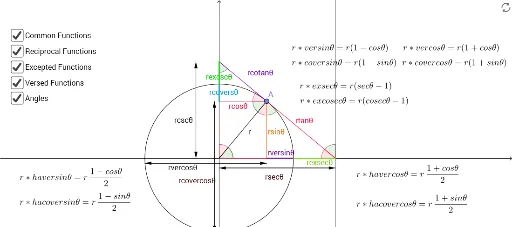
This example demonstrates the trigonometric functions on the unit circle. Key mathematical concepts include trigonometric functions, unit circle, and vectors. Using GeoGebra commands such as Intersect, Circle, and Point, it dynamically shows the graphs of sine, cosine, tangent, etc. Suitable for high school math education and learning.
GeoGebra Commands & Parameters
Intersect(xAxis, yAxis) → A_2Circle(A_2, 1) → cPoint(c) → ASegment(A_2, A) → rLine(A, xAxis) → gOrthogonalLine(A, xAxis) → hIntersect(h, xAxis) → CSegment(A_2, C) → iSegment(C, A) → rsinθOrthogonalLine(A, r) → lIntersect(l, yAxis) → DIntersect(l, xAxis) → ESegment(A_2, E) → mSegment(A_2, D) → nSegment(E, D) → pAngle(C, A_2, A) → θOrthogonalLine(A, n) → qSegment(A, E) → rtanθSegment(A, D) → rcotanθIntersect(q, n) → FSegment(A, F) → rcosθPointIn(c) → PointcIntersect(rsinθ, m) → GIntersect(c, m, 1) → HSegment(G, H) → rversinθSegment(H, E) → rexsecθIntersect(c, n, 1) → ISegment(I, D) → rexcscθSegment(I, F) → rcoversθOrthogonalLine(E, g) → fPoint(f) → JOrthogonalLine(J, f) → jIntersect(j, yAxis) → KSegment(J, K) → rsecθVector(K, J) → uVector(J, K) → vLine(D, xAxis) → kPoint(k) → LOrthogonalLine(L, k) → n_1Intersect(n_1, xAxis) → MVector(L, M) → wVector(M, L) → aSegment(L, M) → rcscθIntersect(rcosθ, rcoversθ) → NIntersect(r, i) → OSegment(O, N) → sOrthogonalLine(P, rcosθ) → tOrthogonalLine(Q, yAxis) → bSegment(F, Q) → rcovercosθPoint(b) → ROrthogonalLine(R, rcosθ) → dIntersect(g, d) → SVector(R, S) → eVector(S, R) → u_1Intersect(c, xAxis, 1) → TOrthogonalLine(T, xAxis) → f_1Point(f_1) → ULine(U, xAxis) → g_1Intersect(h, g_1) → VVector(U, V) → v_1Vector(V, U) → w_1Segment(U, V) → rvercosθIntersect(r, i) → ZIntersect(i, rsinθ) → A_1Intersect(rtanθ, xAxis) → B_1Line(B_1, yAxis) → h_1Point(h_1) → C_1Angle(C_1, B_1, A) → αAngle(A, B_1, A_1) → δPoint(rcosθ) → WAngle(F, A, A_2) → γAngle(D, A, F) → ζAngle(A_2, A, C) → βAngle(C, A, E) → εAngle(I, D, A) → ιAngle(r, s) → η