
Triangle to Conic
Loading the math board and drawing, please wait…
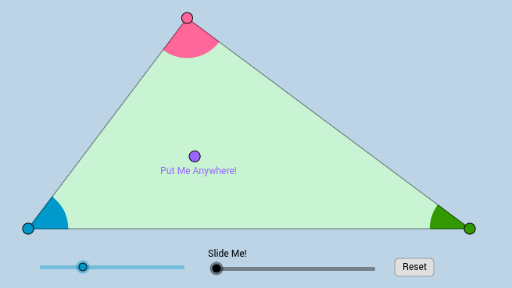
This example demonstrates how to construct conic sections using the vertices and sides of a triangle. It involves core mathematical concepts such as conic sections (circle, ellipse, hyperbola, parabola), functions, differential equations, and quadratic equations. Key GeoGebra commands/objects used include Line, Rotate, Angle, Ray, Point, Segment, Polygon, PointIn, Intersect, Conic, Focus, Vertex, Min, Circle, CircleSector, Dilate, Vector, and Translate. Suitable for high school students and above to understand the geometric construction of conic sections.
GeoGebra Commands & Parameters
Line(A, B) → fRotate(B, α, A) → B'Angle(B, A, B') → βRay(A, B') → gPoint(g) → CSegment(C, B) → hPolygon(A, B, C) → poly1, c, a, bPointIn(poly1) → DLine(D, f) → iLine(D, h) → jLine(D, g) → kIntersect(k, h) → EIntersect(f, k) → FIntersect(i, g) → GIntersect(j, g) → HIntersect(h, i) → IIntersect(f, j) → JConic(F, J, I, E, H) → dFocus(d) → K, LVertex(d) → M, N, O, PSegment(A, B) → lSegment(C, A) → mMin({l, m, h}) → eCircle(A, (0.15 * e)) → pCircle(C, (0.15 * e)) → qCircle(B, (0.15 * e)) → rIntersect(q, m, 1) → QIntersect(q, h, 1) → RIntersect(p, l, 1) → SIntersect(p, m, 1) → TIntersect(r, l, 1) → UIntersect(r, h, 1) → VCircleSector(C, Q, R) → sCircleSector(A, S, T) → tCircleSector(B, V, U) → c_1Dilate(D, If[0 < n ≤ 1, 1 - n, 0], I) → D'Dilate(D, If[0 < n ≤ 1, 1 - n, 0], G) → D'_1Segment(D, D') → f_1Segment(D, D'_1) → g_1Dilate(A, If[1 < n ≤ 2, 2 - n, 0], G) → A'Vector(A, A') → uTranslate(t, u) → t'CircleArc(A, S, T) → d_1Dilate(D, If[2 < n ≤ 3, 3 - n, 0], E) → D'_2Dilate(D, If[2 < n ≤ 3, 3 - n, 0], F) → D'_3Segment(D, D'_2) → h_1Segment(D, D'_3) → i_1Dilate(C, If[3 < n ≤ 4, 4 - n, 0], E) → C'Vector(C, C') → vTranslate(s, v) → s'CircleArc(C, Q, R) → e_1Dilate(D, If[4 < n ≤ 5, 5 - n, 0], J) → D'_4Dilate(D, If[4 < n ≤ 5, 5 - n, 0], H) → D'_5Segment(D, D'_4) → j_1Segment(D, D'_5) → k_1Dilate(B, If[5 < n ≤ 6, 6 - n, 0], J) → B'_1Vector(B, B'_1) → wTranslate(c_1, w) → p_1CircleArc(B, V, U) → q_1