
Triangle on a Line with Missing Angle Measures
Loading the math board and drawing, please wait…
In collections
Some terms & definitions. Angles, angle pairs, angle measure
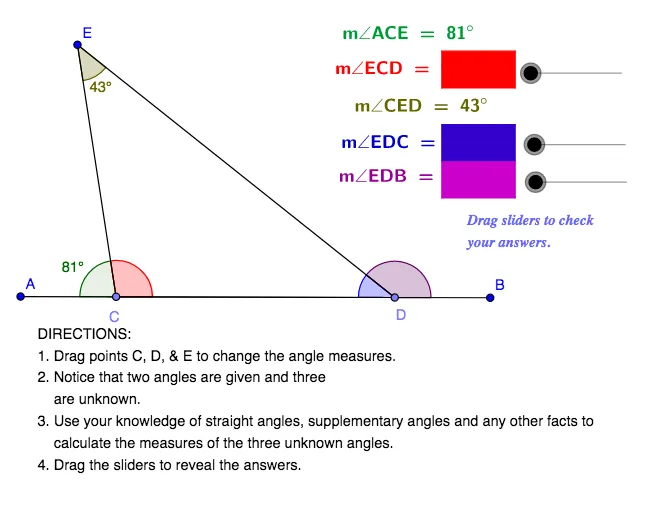
This interactive example shows how to find the missing angle measures when several angles related to a triangle are not given and must be inferred from geometric angle relationships. The main ideas include straight-line (linear pair) angle relationships, the triangle angle-sum principle, and (where applicable) angle relationships arising from positioning on a line and using consistent constructions to set up solvable constraints. Construction uses GeoGebra tools such as Segment and Point to create the base line and triangle vertices, Polygon to form the triangle region, and Angle to label multiple angles to be determined (e.g., α, β, γ, δ, ε). A transformation command like Translate is used to reposition elements so the angle relationships align with the intended configuration. The setup is suitable for middle to high school learners and for practice on geometry angle-chasing problems.
GeoGebra Commands & Parameters
Segment(A, B) → aPoint(a) → CPoint(a) → DPolygon(C, D, E) → P, e, c, dAngle(E, C, A) → αAngle(D, C, E) → βAngle(E, D, C) → γAngle(C, E, D) → δAngle(B, D, E) → εPolygon(F, G, H, I) → Q, f, g, h, iPolygon(J, K, L, M) → R, j, k, l, mPolygon(N, O, S, T) → U, n, o, s, tTranslate(F, u) → F'Translate(G, u) → G'Translate(H, u) → H'Translate(I, u) → I'Polygon(F', G', H', I') → Q', f', g', h', i'Translate(J, v) → J'Translate(K, v) → K'Translate(L, v) → L'Translate(M, v) → M'Polygon(J', K', L', M') → R', j', k', l', m'Translate(N, w) → N'Translate(O, w) → O'Translate(S, w) → S'Translate(T, w) → T'Polygon(N', O', S', T') → U', n', o', s', t'
AI Drawing Prompt Reference
Construct a triangle on a straight base line, then label several related angles. Start by drawing a segment to serve as the main base, choose three vertex positions on/around it, and form the triangular polygon from these points. At key vertices, mark multiple angles that correspond to straight-line (linear pair) relations and the triangle’s angle relationships, using five angle symbols to indicate the specific angle measures to be determined. Finally, create additional similar polygon regions by copying and translating the configuration so the same angle setup appears in other nearby positions for comparison.
The prompt above was compiled from the original drawing commands and is for reference only.