
Triangle Centroid Property: Midpoints, Vectors, and Transformations
Loading the math board and drawing, please wait…
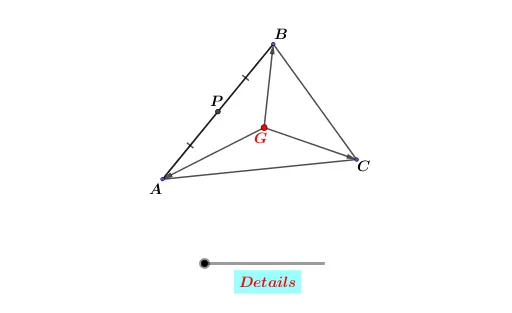
This GeoGebra example demonstrates the centroid property of a triangle by showing how the centroid relates to vertex connections, midpoints, and vector directions. It centers on key concepts: the centroid of a triangle (Centroid), representing geometric directions with vectors (Vector), constructing and connecting midpoints and segments (Midpoint, Segment), and validating relationships using geometric transformations such as reflection, rotation, and dilation (Mirror, Rotate, Dilate). Construction uses Polygon to create the triangle, computes the centroid point G with Centroid, and then draws essential lines with Segment while using Vector to indicate direction/translation relationships involving G and related points (e.g., points tied to parameters like t1). The commands Mirror, Dilate, and Rotate generate transformed configurations to visually confirm the centroid property and its geometric consequences. Point objects and labels (including A, B, C, G, P and several auxiliary points) help link the theory to the constructed diagram. Suitable for secondary school through early university, especially for geometry construction, vector-based reasoning, and transformation-assisted proofs.
GeoGebra Commands & Parameters
Polygon(A, B, C) → t1, c, a_{1}, bCentroid(t1) → GVector(G, A) → uVector(G, B) → vVector(G, C) → wMidpoint(c) → PSegment(P, B) → fSegment(P, A) → gMirror(G, P) → G'Dilate(G, If[0 < a ≤ 1, 1 - a, 0], G') → TVector(G, T) → eSegment(G', A) → kSegment(G', B) → lRotate(T, If[1 < a ≤ 2, ((1 - a) * π), 0], G) → T'Vector(G, T') → j
AI Drawing Prompt Reference
Draw a triangle with three vertices. Locate its centroid and draw arrow vectors from the centroid to each vertex. Take the midpoint of one side and connect it to the other two vertices with segments. Reflect the centroid across this midpoint to get a new point. Dilate this new point about the centroid by a variable scale factor to obtain another point, and draw a vector from the centroid to it. Connect the reflected point to two vertices with segments. Then rotate the dilated point about the centroid by a variable angle to get a final point, and draw a vector from the centroid to that point.
The prompt above was compiled from the original drawing commands and is for reference only.