
Triangle Area and Parallelogram Area Relationship
Loading the math board and drawing, please wait…
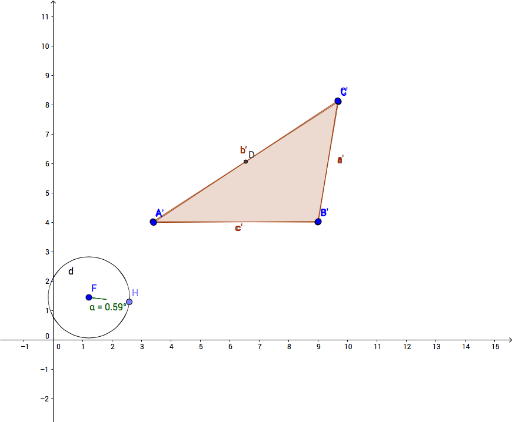
This GeoGebra example dynamically demonstrates the relationship between the area of a triangle and that of a parallelogram, showing that a triangle's area equals half the area of a parallelogram with the same base and height. Core mathematical concepts include area formulas, properties of parallelograms, triangle area calculation, and the geometric interpretation of the Pythagorean theorem. The construction uses GeoGebra commands such as Polygon to create the shapes, Midpoint, Circle, Point, Angle, and Rotate to generate symmetric copies and transformations, linking the figures dynamically. It is suitable for middle school geometry lessons, helping students understand area derivation and transformation thinking.
GeoGebra Commands & Parameters
Polygon(A, B, C) → poly1, c, a, bMidpoint(b) → DCircle(F, 1.3801449199268887) → dPoint(d) → GPoint(d) → HAngle(G, F, H) → αRotate(A, Angle[G, F, H], D) → A'Rotate(B, Angle[G, F, H], D) → B'Rotate(C, Angle[G, F, H], D) → C'Polygon(A', B', C') → poly1', c', a', b'
AI Drawing Prompt Reference
Draw a triangle ABC, find the midpoint D of side BC. Draw a circle with center F and radius 1.38, and select points G and H from it. Rotate points A, B, and C around D by the angle ∠GFH to get A', B', and C', forming a parallelogram A'B'C' with the same base and height as the original triangle.
The prompt above was compiled from the original drawing commands and is for reference only.