
Trapezoids and Kites: Incircles and Similarity Transformations
Loading the math board and drawing, please wait…
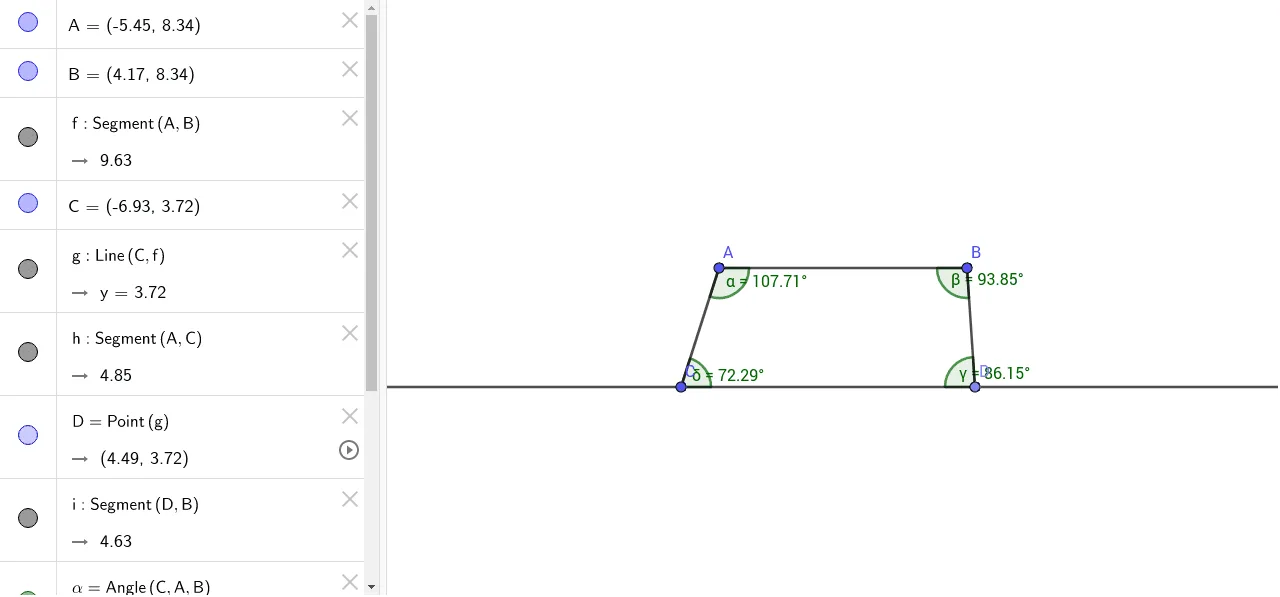
This GeoGebra example dynamically constructs trapezoids and kites, highlighting their incircles and the effects of similarity transformations on these quadrilaterals. The core mathematical concepts include quadrilateral classification, conditions for an incircle (e.g., a kite has an incircle when opposite angles are equal; a trapezoid has one when the sum of the legs equals the sum of the bases), and how similarity transformations preserve shape while scaling area. The construction uses GeoGebra commands such as Segment, Line, Point, and Angle, creating vertices A, B, C, D, edges f, g, h, and angles α, β, γ, δ. By dragging points, users can explore how changes affect the incircle and similarity relationships. This resource is ideal for middle and high school geometry classes, helping students visualize incircle conditions, similarity properties, and dynamic geometric verification. It also offers a bridge to discussing area and standard deviation as analogies for data spread versus geometric shape.
GeoGebra Commands & Parameters
Segment(A, B) → fLine(C, f) → gSegment(A, C) → hPoint(g) → DSegment(D, B) → iAngle(C, A, B) → αAngle(A, B, D) → βAngle(B, D, C) → γAngle(D, C, A) → δ