
Trapezoid Area and Volume via Differential Calculus
Loading the math board and drawing, please wait…
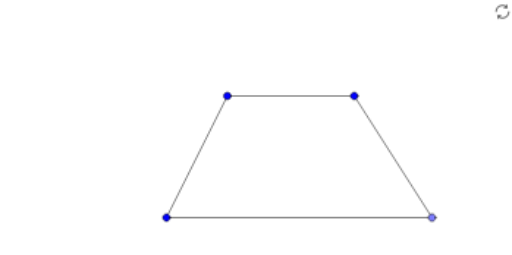
①This GeoGebra example dynamically demonstrates a trapezoid and its related geometric quantities, using differential calculus (derivatives) to explore how the area or volume changes with parameters. ②Core mathematical concepts include trapezoids, quadrilaterals, coordinate geometry, volume, and derivatives, focusing on instantaneous rates of change of geometric measures. ③Construction details: Using GeoGebra commands such as Segment, Line, and Point, objects A, B, f, C, g, D, h, i, j are created; f, g, h, i, j likely represent auxiliary lines or curves, and the trapezoid model is built through point-line associations for dynamic adjustment. ④Suitable for high school or early college students to understand the integration of geometry and calculus, and to explore derivative applications in geometric problems via dynamic geometry software.
GeoGebra Commands & Parameters
Segment(A, B) → fLine(C, f) → gPoint(g) → DSegment(A, C) → hSegment(B, D) → iSegment(D, C) → j
AI Drawing Prompt Reference
Draw a trapezoid ABCD with A and B as the endpoints of the base, and C and D as the intersection points of the non-parallel sides. Create segment f through points A and B as the base, line g through point C and segment f, with point D on line g. Create segment h through points A and C, and segment i through points B and D, and segment j through points D and C.
The prompt above was compiled from the original drawing commands and is for reference only.