
Translation Activity: Geometric Transform and Confidence Interval Visualization
Loading the math board and drawing, please wait…
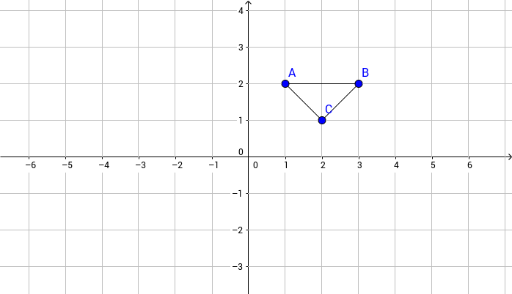
This GeoGebra example demonstrates the geometric transformation of translation, integrating concepts such as confidence intervals, arithmetic mean, rhombus constructions, and upper/lower Riemann sums. The activity focuses on moving objects or function graphs along a specified direction and observing how their positions affect statistical measures or geometric properties. Key construction steps involve using the Segment command to create segments and defining objects A, B, f, C, g, h, where f may represent a function, and g and h are translated results or auxiliary lines. Suitable for secondary school mathematics or introductory university statistics, this activity helps learners intuitively grasp translation in geometry and function graphs, and explore the geometric meaning of confidence intervals and Riemann sums through dynamic manipulation.
GeoGebra Commands & Parameters
Segment(A, B) → fSegment(C, B) → gSegment(C, A) → h
AI Drawing Prompt Reference
Draw a diagram combining geometric translation with statistical visualization. Start with three non-collinear points, connect two of them with a segment, then draw segments from the third point to each of the other two, forming a triangle. Translate this entire triangle along a specified direction to create a new triangle, using dashed lines or different colors to distinguish the original and translated shapes. Additionally, include a horizontal number line with several data points and their mean marked, shade the confidence interval region, and draw step-like lines at the interval boundaries to represent upper and lower Riemann sums. Emphasize how translation shifts the geometric shape and how statistical measures change accordingly.
The prompt above was compiled from the original drawing commands and is for reference only.