
Timed Coordinates Boat Game
Loading the math board and drawing, please wait…
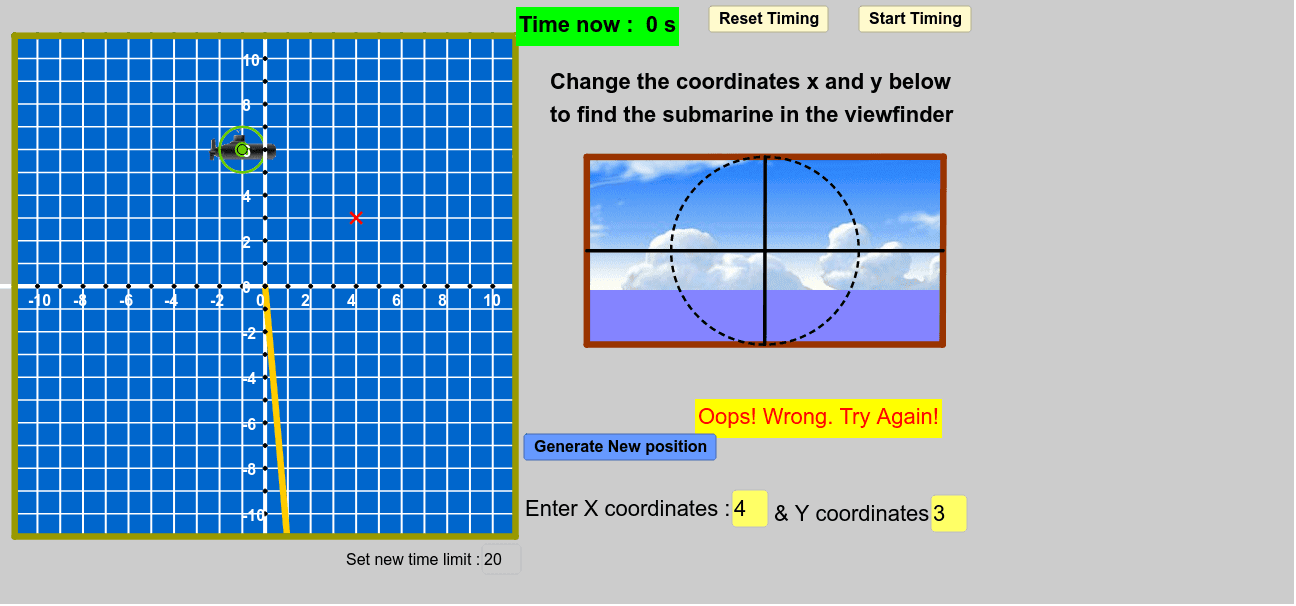
This example demonstrates a coordinate geometry game enhanced with a timer for added challenge, helping learners grasp coordinate systems. Core math concepts include coordinate geometry, complex numbers, trapezoids, linear programming or optimization, sine functions, and right triangles. Construction highlights the use of GeoGebra commands like Random, Circle, Ray, OrthogonalLine, Intersect, CircumcircleArc, Midpoint, Sequence, If, Segment, Polygon, Line, Rotate, Mod, Point, and Textfield; objects such as O, bb, aa, cc, C_1, α, K, A, yA, xA, rr, A', v, c', a, b, B, C, D, T, d, E, F_2, e, f, G, H, g, I, h, liste3, dist, xB, yB, J, k, liste4, ang, raz, L. Suitable for high school students studying coordinate geometry and optimization problems.
GeoGebra Commands & Parameters
Random(-10, 10) → bbRandom(-10, 10) → aaRandom(-10, 10) → ccRandom(4, 15) → rrCircle(A, (((1.5 * v) - 1) * rr)) → c'Ray(A, (0, 0)) → aOrthogonalLine(A, a) → bIntersect(c', b) → B, CIntersect(c', a) → D, TCircumcircleArc(B, D, C) → dMidpoint(C, D) → EMidpoint(B, D) → F_2Ray(A', E) → eRay(A', F_2) → fIntersect(d, e) → G,Intersect(d, f) → H,CircumcircleArc(G, D, H) → gCircle(I, 1) → hSequence(Text[If[s < 10, " ", ""] + (s), (21.6 + (2 * Mod[s - 1, 3]), 7.75 - (2 * Div[s - 1, 3]))], s, 1, 12) → liste3Circle(J, 1) → kSequence(Text[If[s ≟ 1, " ", If[s < 5, " ", ""]] + ((30 * (s - 1))) + "º", (21.25 + (2 * Mod[s - 1, 3]), (-6.25) - (2 * Div[s - 1, 3]))], s, 1, 12) → liste4If(yB > (-5), 5*°, ((((xB - (3 * yB)) / 2 - 19 - 1) * 30))°) → angIf(ang ≟ α ∧ dist ≟ rr, true, false) → razSegment(O, N) → mCircle(A, (((2 * v) - 1) * rr) - n) → pSequence(Circle[A, (((1.5 * v) - 1) * rr) - i], i, 0, n, n / 10) → liste5Polygon(P, Q, R, S) → poly1, p_1, q, r_1, sCircle((0, 0), If[((2 * v) * rr) > 12, 0, ((2 * v) * rr)]) → cMidpoint(K, L) → UMidpoint(U, L) → VMidpoint(U, V) → WMidpoint(V, L) → ZSegment(K, C_1) → lLine(A, l) → iSegment(A, U) → tIntersect(c, t) → A_1, B_1Segment(U, A_1) → a_1Rotate(C_1, (6 * v), U) → L'Segment(U, L') → b_1Mod((v * 100), 2) → abSegment(O, D_1) → jCircle(O, C_1) → g_1Point(g_1) → E_1Segment(O, E_1) → h_1Circle(F_1, 6.5 - abs(r / 4.5)) → q_1Line(F_1, l) → i_1Intersect(q_1, i_1) → G_1, H_1Line(J_1, r_1) → j_1Point(j_1) → N_1Line(N_1, l) → l_1Line(J_1, l) → m_1Point(m_1) → O_1Point(l_1) → P_1Intersect(l_1, r_1) → M_1Polygon(M_1, N_1, J_1, F) → poly2, m_2, n_1, j_2, f_2Point(l_1) → Q_1Point(m_1) → R_1Polygon(P_1, Q_1, R_1, O_1) → poly3, p_2, q_2, r_2, o_1Point(j_1) → S_1Polygon(S_1, T_1, O_1, J_1) → poly4, s_1, t_1, o_2, j_3Midpoint(s_1) → V_1Midpoint(o_2) → W_1Midpoint(S_1, J_1) → Z_1Midpoint(t_1) → A_2Segment(V_1, W_1) → a_2Segment(Z_1, A_2) → b_2Intersect(b_2, a_2) → B_2Circle(B_2, V_1) → c_2Sequence((x(O) + i, y(D_1)), i, -11, 11, 1) → liste1Sequence((x(N) + i, y(N)), i, -11, 11, 1) → liste6Sequence((x(C_1), y(C_1) + i), i, -11, 11, 1) → liste7Sequence((x(E_1), y(E_1) + i), i, -11, 11, 1) → liste8Ray(M_1, T_1) → c_1Sequence(Segment[Element[liste8, i], Element[liste7, i]], i, 0, 22) → liste10Sequence((x(D_1) + i, 0), i, -11, 11) → liste2Sequence(Segment[Element[liste1, i], Element[liste6, i]], i, 0, 22) → liste9Line(S, P) → d_1Line(J_1, S_1) → e_1Line(Q_1, e_1) → f_1Intersect(d_1, s) → MIntersect(d_1, f_1) → C_2Line(R, d_1) → k_1Intersect(e_1, k_1) → D_2Polygon(S, C_2, Q_1, S_1, D_2, R) → poly5, s_2, c_3, q_3, s_3, d_2, r_3Point(d_1) → E_2Line(E_2, p_1) → e_2Intersect(k_1, e_2) → G_2Polygon(E_2, P, Q, G_2) → poly6, e_3, p_3, q_4, g_2Sequence(O + (i, 0), i, -10, 10) → liste11Sequence(O + (0, i), i, -10, 10) → liste12Sequence(i, i, -10, 10) → liste13Sequence(Text[Element[liste13, i], (x(Element[liste11, i] - 0.42), y(Element[liste11, i] - 0.85))], i, 1, Length[liste13], 2) → liste14Sequence(Text[Element[liste13, i], (x(Element[liste12, i] - 1), y(Element[liste12, i] - 0.31))], i, 1, Length[liste13], 2) → liste15Textfield(o) → inputBox1Textfield(r) → inputBox2Textfield(timelimit) → inputBox3