
Tilted Duct: Pythagorean Theorem and Geometric Construction
Loading the math board and drawing, please wait…
In collections
Rate & Accumulation Yr 4 Much&Fast
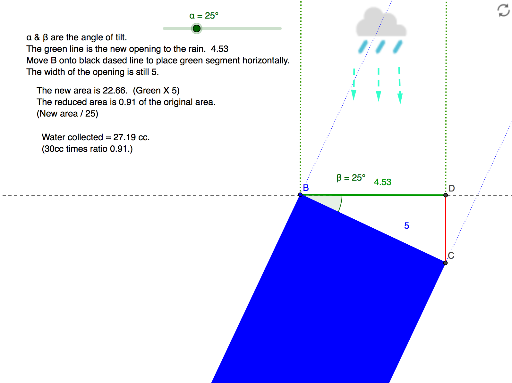
This GeoGebra example demonstrates a geometric figure called 'Tilted Duct', which involves rotations, circles, perpendicular lines, and polygons to explore problems related to area and ratio, likely based on the Pythagorean theorem. The core mathematical concepts include right triangles, the Pythagorean theorem, circumcircles, median values, exponential functions, and variance, showing an interdisciplinary connection. The construction uses GeoGebra commands such as Rotate, Angle, Ray, Circle, Intersect, OrthogonalLine, Segment, Line, Point, Polygon, and Vector, creating a complex diagram with multiple points, lines, circles, and polygons. It is suitable for high school or early college students to investigate geometric theorems combined with algebra and statistics, and can serve as a case for mathematical modeling or integrated applications.
GeoGebra Commands & Parameters
Rotate(A, α, B) → A'Angle(A, B, A') → βRay(B, A) → aRay(B, A') → bCircle(B, 5) → cIntersect(c, a) → C,OrthogonalLine(C, b) → dIntersect(b, d) → DSegment(B, D) → eSegment(D, C) → fSegment(C, B) → gOrthogonalLine(B, g) → hOrthogonalLine(C, g) → iLine(B, d) → jLine(D, xAxis) → kPoint(j) → EPoint(d) → FRay(D, F) → lRay(B, E) → mPoint(h) → GPoint(i) → HPolygon(G, B, C, H) → poly1, g_1, b_1, c_1, h_1Vector(K, L) → uVector(M, N) → vVector(O, P) → w