
Tiling with Whole Number Squares
Loading the math board and drawing, please wait…
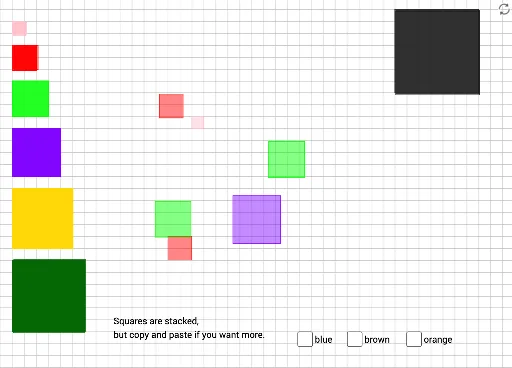
This example demonstrates how to tile the plane using squares with integer side lengths, exploring the minimum number of squares needed. It involves core concepts like geometric tiling, sequences, and optimization. The construction uses commands such as Polygon, with objects like A, B, and functions f, g, h to define and arrange the squares. Suitable for middle school students and above to learn about geometric constructions and sequences, or for exploring space-filling patterns.
GeoGebra Commands & Parameters
Polygon(A, B, 4) → poly1, f, g, h, i, C, DPolygon(E, F, 4) → poly2, j, k, l, m, G, HPolygon(I, J, 4) → poly3, n, p, q, r, K, LPolygon(M, N, 4) → poly4, s, t, a, b, O, PPolygon(Q, R, 4) → poly5, c, d, e, f_1, S, TPolygon(E_1, F_1, 4) → poly2_1, j_1, k_1, l_1, m_1, G_1, H_1Polygon(A_1, B_1, 4) → poly1_1, f_2, g_1, h_1, i_1, C_1, D_1Polygon(I_1, J_1, 4) → poly3_1, n_1, p_1, q_1, r_1, K_1, L_1Polygon(E_2, F_2, 4) → poly2_2, j_2, k_2, l_2, m_2, G_2, H_2Polygon(I_2, J_2, 4) → poly3_2, n_2, p_2, q_2, r_2, K_2, L_2Polygon(M_1, N_1, 4) → poly4_1, s_1, t_1, a_1, b_1, O_1, P_1Polygon(M_2, N_2, 4) → poly4_2, s_2, t_2, a_2, b_2, O_2, P_2Polygon(Q_1, R_1, 4) → poly5_1, c_1, d_1, e_1, f_3, S_1, T_1Polygon(Q_2, R_2, 4) → poly5_2, c_2, d_2, e_2, f_4, S_2, T_2Polygon(U, V, 4) → poly6, g_2, h_2, i_2, g_3, W, ZPolygon(U_1, V_1, 4) → poly7, h_3, i_3, j_3, k_3, W_1, Z_1Polygon(U_2, V_2, 4) → poly6_1, g_4, h_4, i_4, g_5, W_2, Z_2Polygon(M_3, N_3, 4) → poly4_3, s_3, t_3, a_3, b_3, O_3, P_3Polygon(E_3, F_3, 4) → poly2_3, j_4, k_4, l_3, m_3, G_3, H_3Polygon(M_4, N_4, 4) → poly4_4, s_4, t_4, a_4, b_4, O_4, P_4Polygon(U_3, V_3, 4) → poly6_2, g_6, h_5, i_5, g_7, W_3, Z_3Polygon(E_4, F_4, 4) → poly2_4, j_5, k_5, l_4, m_4, G_4, H_4Polygon(E_5, F_5, 4) → poly2_5, j_6, k_6, l_5, m_5, G_5, H_5Polygon(M_5, N_5, 4) → poly4_5, s_5, t_5, a_5, b_5, O_5, P_5Polygon(M_6, N_6, 4) → poly4_6, s_6, t_6, a_6, b_6, O_6, P_6Polygon(E_6, F_6, 4) → poly2_6, j_7, k_7, l_6, m_6, G_6, H_6Polygon(E_7, F_7, 4) → poly2_7, j_8, k_8, l_7, m_7, G_7, H_7Polygon(A_2, B_2, 4) → poly1_2, f_5, g_8, h_6, i_6, C_2, D_2Polygon(I_3, J_3, 4) → poly3_3, n_3, p_3, q_3, r_3, K_3, L_3Polygon(A_3, B_3, 4) → poly1_3, f_6, g_9, h_7, i_7, C_3, D_3Polygon(A_4, B_4, 4) → poly1_4, f_7, g_{10}, h_8, i_8, C_4, D_4Polygon(Q_3, R_3, 4) → poly5_3, c_3, d_3, e_3, f_8, S_3, T_3Polygon(I_4, J_4, 4) → poly8, n_4, p_4, q_4, r_4, K_4, L_4Polygon(Q_4, R_4, 4) → poly9, c_4, d_4, e_4, n_5, S_4, T_4Polygon(U_4, V_4, 4) → poly10, p_5, q_5, r_5, c_5, W_4, Z_4Polygon(Q_5, R_5, 4) → poly5_4, c_6, d_5, e_5, f_9, S_5, T_5Polygon(U_5, V_5, 4) → poly6_3, g_{11}, h_9, i_9, g_{12}, W_5, Z_5Polygon(U_6, V_6, 4) → poly6_4, g_{13}, h_{10}, i_{10}, g_{14}, W_6, Z_6Polygon(U_7, V_7, 4) → poly6_5, g_{15}, h_{11}, i_{11}, g_{16}, W_7, Z_7Polygon(U_8, V_8, 4) → poly7_1, h_{12}, i_{12}, j_9, k_9, W_8, Z_8Polygon(U_9, V_9, 4) → poly7_2, h_{13}, i_{13}, j_{10}, k_{10}, W_9, Z_9Polygon(U_{10}, V_{10}, 4) → poly7_3, h_{14}, i_{14}, j_{11}, k_{11}, W_{10}, Z_{10}Polygon(A_5, B_5, 4) → poly1_5, f_{10}, g_{17}, h_{15}, i_{15}, C_5, D_5Polygon(I_5, J_5, 4) → poly3_4, n_6, p_6, q_6, r_6, K_5, L_5