
The Ambiguous Case of the Sine Rule by Nicola Trubridge
Loading the math board and drawing, please wait…
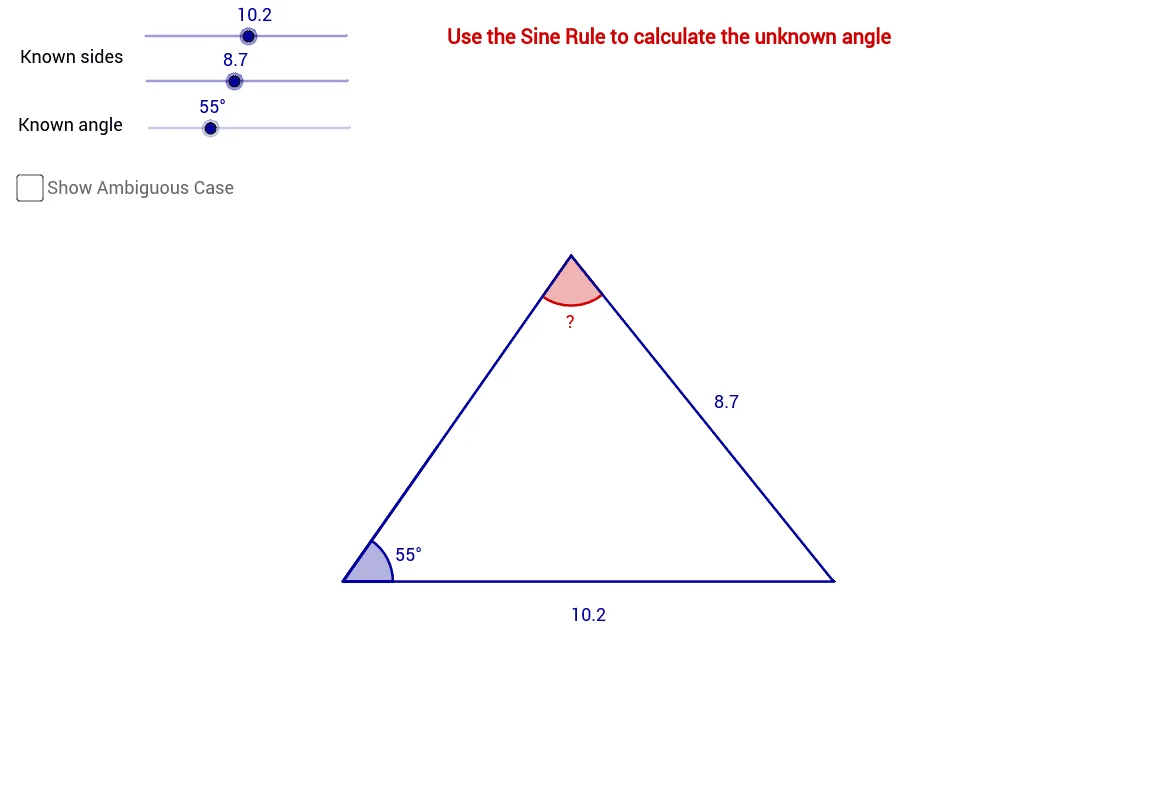
This example demonstrates the ambiguous case of the sine rule in solving triangle problems. The core math concepts involved are the sine rule (law of sines), which is used to solve for unknown angles and sides in a triangle based on known angles and sides. The construction utilizes GeoGebra commands and objects such as Point, Segment, Rotate, Angle, Circle, Ray, Intersect, and OrthogonalLine. It is suitable for high school students learning trigonometry and geometry.
GeoGebra Commands & Parameters
Point(Circle[A, a]) → BSegment(A, B) → bRotate(B, α, A) → B'Angle(B, A, B') → βCircle(B, c) → dRay(A, B') → eIntersect(d, e) → C, DOrthogonalLine(B, e) → fIntersect(d, f, 2) → ESegment(B, C) → gSegment(B, D) → hSegment(A, C) → iSegment(A, D) → jAngle(A, C, B) → γAngle(A, D, B) → δSegment(B, E) → kIntersect(e, f) → FSegment(B, F) → lAngle(A, D, B) → ε
AI Drawing Prompt Reference
Draw a triangle to demonstrate the ambiguous case of the sine rule. Start by drawing a circle with a center at one vertex and radius equal to the opposite side, marking the intersection point. Rotate the known side around the vertex to create a second side, forming a triangle. Then, draw a circle centered at the new vertex with radius equal to the third side, intersecting the rotated side's ray at two points. Connect these points to form two possible triangles. Label all angles and sides, and draw perpendicular lines and intersection points to highlight the geometric relationships in both cases.
The prompt above was compiled from the original drawing commands and is for reference only.