
The Addition Formula for Sine and Cosine: Geometric Proof and Illustration
Loading the math board and drawing, please wait…
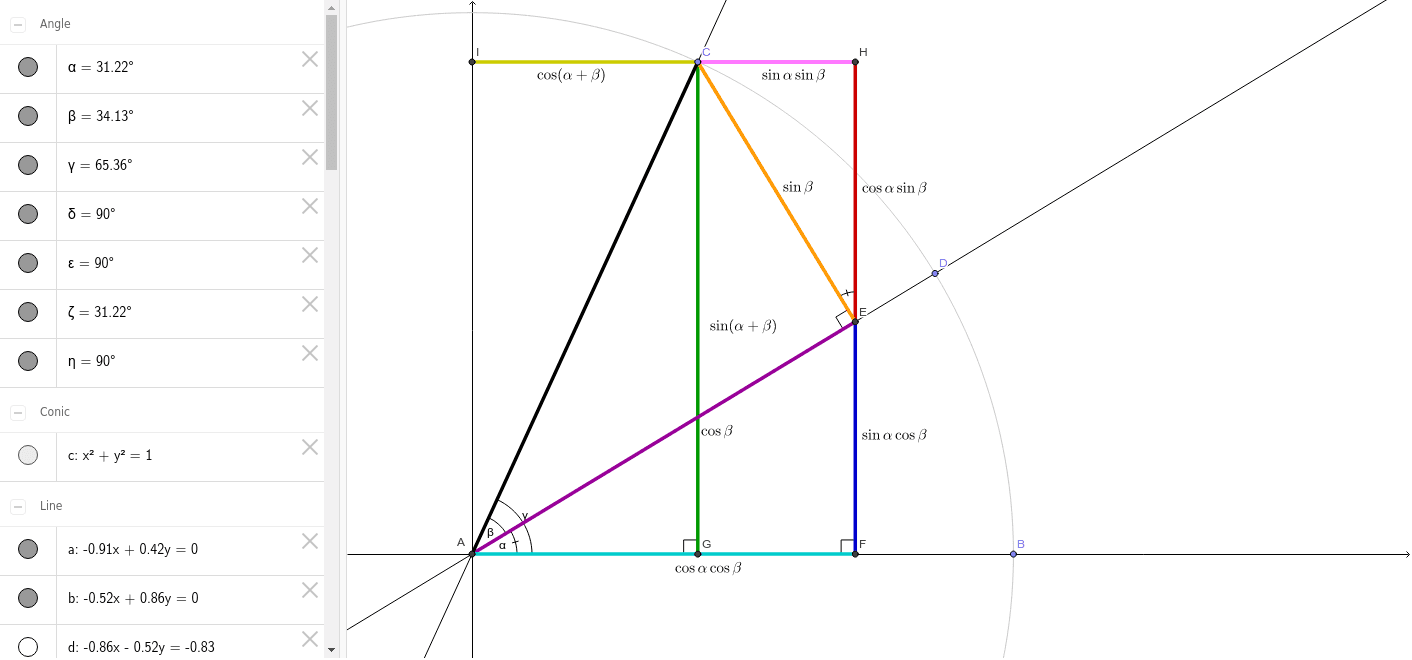
This GeoGebra example provides a dynamic geometric proof and illustration of the addition (and subtraction) formulas for sine and cosine. It demonstrates how the identities sin(α±β) and cos(α±β) arise from the rotation of points on the unit circle and the projection of coordinates. The construction uses a Circle to define the unit circle, Point and Intersect to place key vertices, Line, OrthogonalLine, and Segment to build auxiliary right triangles, and Angle to mark the involved angles α, β, and their combinations. Midpoint and Text objects are used to label segments and display the derived relationships. The example emphasizes geometric construction and transformation (rotation, translation) as a visual proof tool. It is suitable for high school or introductory college students learning trigonometric identities, and serves as an interactive classroom demonstration to bridge geometric intuition and algebraic formulas.
GeoGebra Commands & Parameters
Intersect(xAxis, yAxis) → APoint(xAxis) → BCircle(A, B) → cPoint(c) → CLine(A, C) → aPoint(c) → DLine(A, D) → bOrthogonalLine(C, b) → dOrthogonalLine(C, xAxis) → eIntersect(d, b) → EOrthogonalLine(E, xAxis) → fIntersect(xAxis, f) → FIntersect(xAxis, e) → GOrthogonalLine(C, f) → gIntersect(f, g) → HSegment(C, G) → hSegment(H, E) → iSegment(E, F) → jAngle(B, A, D) → αAngle(D, A, C) → βAngle(B, A, C) → γAngle(E, F, A) → δAngle(C, E, A) → εAngle(H, E, C) → ζSegment(A, E) → kSegment(E, C) → lSegment(A, F) → mSegment(C, H) → nAngle(C, G, A) → ηOrthogonalLine(C, yAxis) → pIntersect(p, yAxis) → ISegment(C, I) → qSegment(A, C) → rMidpoint(C, E) → JMidpoint(E, H) → KMidpoint(E, A) → LMidpoint(G, C) → MMidpoint(F, E) → NMidpoint(A, F) → OMidpoint(I, C) → PMidpoint(C, H) → Q
AI Drawing Prompt Reference
Draw a unit circle centered at the origin on a coordinate plane. Place two points on the circle, and connect each to the center with a radius. Let the angle from the positive x-axis to the first radius be α, and the angle between the two radii be β. From the point on the circle corresponding to the first radius, drop a perpendicular to the second radius, and from that foot, drop another perpendicular to the x-axis. Connect the relevant points to form right triangles. Mark the angles α, β, α+β, and the acute angles of the triangles. Also drop a perpendicular from the circle point to the y-axis, mark its foot, and connect midpoints of key segments to illustrate coordinate projections. The figure demonstrates the geometric proof of sine and cosine addition formulas.
The prompt above was compiled from the original drawing commands and is for reference only.