
Thales' Theorem (Version A) – Interactive Discovery Investigation with Questions
Loading the math board and drawing, please wait…
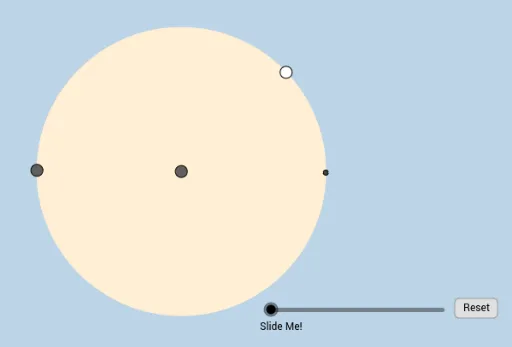
① This interactive GeoGebra example dynamically demonstrates Thales' Theorem: for any point C on a circle with diameter AB, the angle ∠ACB is always a right angle (90°). ② Core mathematical concepts include circles, inscribed angles, right triangles, the relationship between a diameter and a right angle, and theorem discovery through exploration. ③ Construction highlights: using GeoGebra commands such as Circle, Point, Line, Intersect, CircleArc, Segment, Dilate, Rotate, Ray, Min, and CircleSector, with objects including A, B, c, C, a, D, d, e, E, b, h, button1, C', i, A', j, C'_1, C'', i', C'_2, k, D', f, g, F, l, C'_3, m, n, p, G, H, I, q, and q', plus interactive buttons and dynamic measurements. ④ Suitable for middle and high school geometry classes, inquiry-based learning, and teacher demonstrations to help students visualize and reason about geometric theorems.
GeoGebra Commands & Parameters
Circle(A, B) → cPoint(c) → CLine(C, A) → aIntersect(c, a, 2) → DCircleArc(A, C, D) → dCircleArc(A, D, C) → ePoint(e) → ESegment(C, D) → hDilate(C, If[0 < b ≤ 1, 1 - b, 0], A) → C'Segment(C, C') → iDilate(A, If[1 < b ≤ 2, 2 - b, 0], D) → A'Segment(A, A') → jRotate(C, If[2 < b ≤ 3, ((-(b - 2)) * π), (-π)], A) → C'_1Rotate(C', If[2 < b ≤ 3, ((-(b - 2)) * π), (-π)], A) → C''Segment(C'_1, C'') → i'Rotate(C, If[3 < b ≤ 4, ((b - 3) * π), π], A) → C'_2CircleArc(A, C, C'_2) → kDilate(D, If[5 < b ≤ 6, 6 - b, 0], E) → D'Segment(D, D') → fRay(D, E) → gPoint(g) → FRay(E, F) → lDilate(C, If[5 < b ≤ 6, 6 - b, 0], E) → C'_3Segment(C, C'_3) → mMin({m, f}) → nCircle(E, (0.2 * n)) → pIntersect(p, l) → G,Intersect(c, m, 1) → HIntersect(p, m) → I,CircleSector(E, G, I) → qRotate(q, If[6.5 < b ≤ 7.5, ((b - 6.5) * π / 2), π / 2], E) → q'
AI Drawing Prompt Reference
Draw a circle with a fixed diameter defined by two endpoints. Place a point on the circle and connect it to both endpoints to form a triangle. Add another point on the circle and construct an arc through it. Using a slider, sequentially show: a segment shrinking from the circle point toward an endpoint, a rotated arc with its chord, and a sector formed by a ray from the arc point intersecting the circle. All dynamic changes illustrate that the angle subtended by the diameter is always a right angle. Include the circle, diameter, triangle, arcs, rays, sector, and several auxiliary points.
The prompt above was compiled from the original drawing commands and is for reference only.