
Tessellations with Equilateral Triangles
Loading the math board and drawing, please wait…
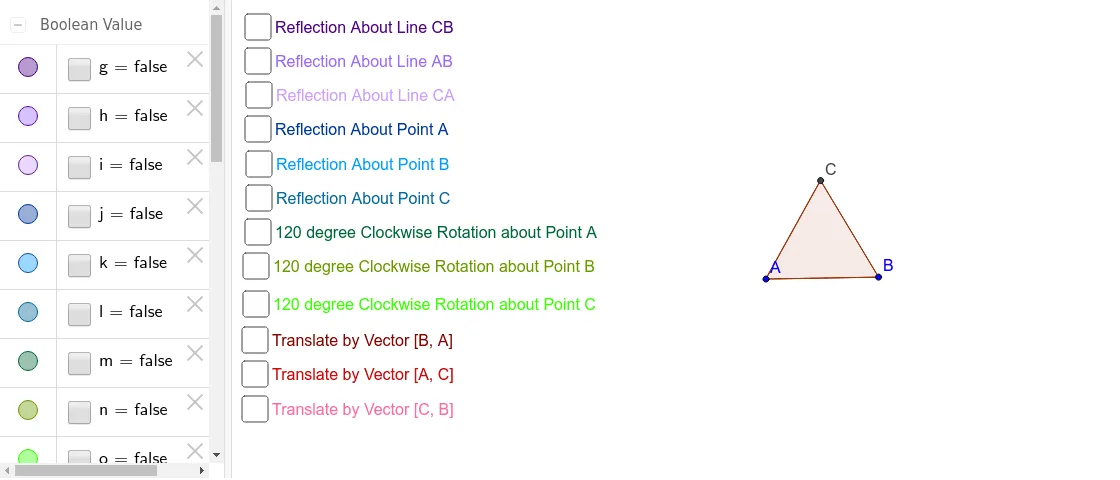
This example demonstrates the concept of tessellations using equilateral triangles, covering core math concepts like triangle properties, tiling principles, vector operations, and geometric transformations. It utilizes GeoGebra commands such as Polygon, Line, Mirror, Rotate, Vector, and Translate as outlined in the construction summary. Ideal for high school mathematics education to explore geometric transformations and tiling patterns.
GeoGebra Commands & Parameters
Polygon(A, B, 3) → poly1, a, b, c, CLine(C, B) → dLine(A, B) → eLine(C, A) → fMirror(poly1, b) → poly1'Mirror(poly1, a) → poly1'_1Mirror(poly1, c) → poly1'_2Mirror(poly1, C) → poly1'_3Mirror(poly1, B) → poly1'_4Mirror(poly1, A) → poly1'_5Rotate(poly1, -120*°, B) → poly1'_6Rotate(poly1, -120*°, A) → poly1'_7Rotate(poly1, -120*°, C) → poly1'_8Vector(B, A) → uTranslate(poly1, u) → poly1'_9Vector(A, C) → vTranslate(poly1, v) → poly1'_{10}Vector(C, B) → wTranslate(poly1, w) → poly1'_{11}
AI Drawing Prompt Reference
Draw a tessellation pattern composed of equilateral triangles, starting with a single triangle and then replicating it through mirroring and rotation to arrange the copies into a regular hexagonal grid, demonstrating the principles of triangle tiling and geometric transformations.
The prompt above was compiled from the original drawing commands and is for reference only.