
Tautochrone
Loading the math board and drawing, please wait…
In collections
El dominio del Tiempo (cinemática intuitiva)
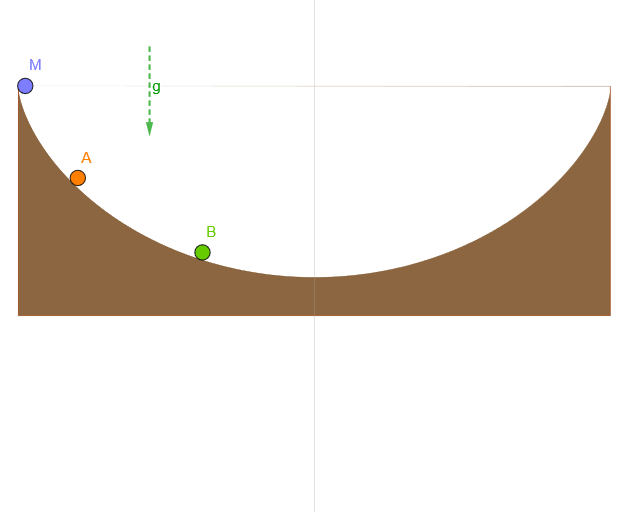
This example demonstrates the tautochrone curve, where an object slides from one point to another under gravity in the same amount of time. Key mathematical concepts include parametric equations, vectors, and limits. Using GeoGebra commands such as CurveCartesian, Point, If, Tangent, etc., the construction process of the tautochrone curve is dynamically shown. Suitable for high school mathematics education and research.
GeoGebra Commands & Parameters
CurveCartesian(((α * r), r) + (r; α + pi / 2), α, 0, (2 * pi)) → cPoint(c) → MIf(Length[reg] ≟ 1, {reg(1)}, Sequence[reg(k) - reg(k + 1), k, 1, Length[reg] - 1]) → regDifmean(regDif) → TTangent(M, c) → iUnitVector(i) → nPoint(c) → ATangent(A, c) → iAUnitVector(iA) → nAPoint(c) → BTangent(B, c) → iBUnitVector(iB) → nBMirror(Hnor, Line[S, S + (0, 1)]) → Hnor'Locus(P, M) → lugar1
AI Drawing Prompt Reference
Draw a cycloid curve that demonstrates the tautochrone property, where an object slides under gravity in the same time from one point to another. The curve should show a starting point and ending point, with the object moving smoothly along the curve. Ensure the curve is clear, symmetric, and periodic.
The prompt above was compiled from the original drawing commands and is for reference only.