
Tangent Values and Nested Triangles
Loading the math board and drawing, please wait…
In collections
Trigonometry: Basic and More
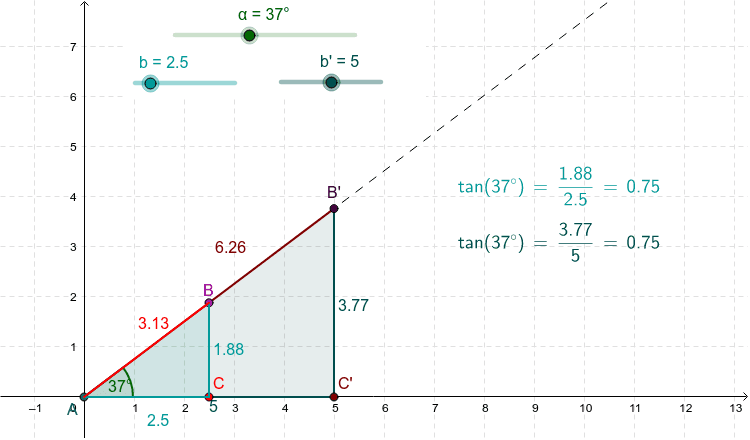
This example demonstrates the geometric definition of the tangent function using nested similar triangles. It involves core concepts like similar triangles, tangent function definition, and trigonometric relationships. GeoGebra commands used include Point, Intersect, Rotate, Angle, Ray, OrthogonalLine, and Polygon. Suitable for high school students learning the geometric meaning of trigonometric functions.
GeoGebra Commands & Parameters
Point(xAxis) → ZIntersect(xAxis, yAxis) → ARotate(Z, α, A) → Z'Angle(Z, A, Z') → βRay(A, Z') → zOrthogonalLine(C, xAxis) → b_3Intersect(b_3, z) → BOrthogonalLine(C', xAxis) → a'_1Intersect(a'_1, z) → B'Polygon(A, C, B) → poly1, b_1, a, cPolygon(A, C', B') → poly2, b'_1, a', c'
AI Drawing Prompt Reference
Draw a coordinate system with an x-axis and y-axis. Take a point on the x-axis, intersect it with the y-axis at the origin. Rotate this point around the origin by angle α to get a new point. Connect the origin to this new point to form a ray. Take another point on the x-axis, draw a perpendicular line from this point to the ray, and mark the intersection. Form two similar nested triangles using the origin, the intersection point on the x-axis, and the intersection point on the ray, demonstrating the geometric definition of the tangent function.
The prompt above was compiled from the original drawing commands and is for reference only.