
Surface of Revolution: Generating 3D Solids by Rotating a Curve
Loading the math board and drawing, please wait…
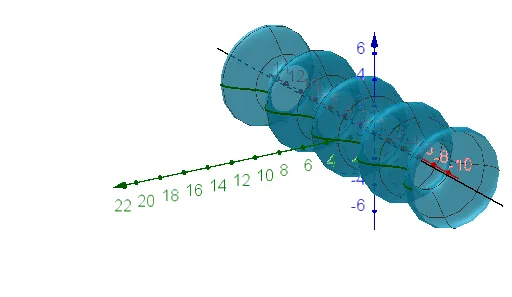
① This example demonstrates how a 3D surface of revolution is created by rotating a planar curve (a function graph) around a fixed axis, visualizing the transition from 2D to 3D geometry. ② Core mathematical concepts include solids of revolution, parametric surfaces, function graphs, geometric transformations, and the relationship to volume and surface area, incorporating trigonometry, the unit circle, and linear functions. ③ Construction highlights: using GeoGebra's Surface command with objects k (axis), f (curve function), α (rotation angle), and auxiliary elements m, c, g, a, allowing dynamic adjustment of parameters to explore shape variations. ④ Suitable for high school to early college students, ideal for solid geometry, introductory calculus (volumes of revolution), or interactive math visualization, serving as a teaching tool for demonstrating how rotating curves generate 3D solids.
GeoGebra Commands & Parameters
Surface(f, α, g) → a