
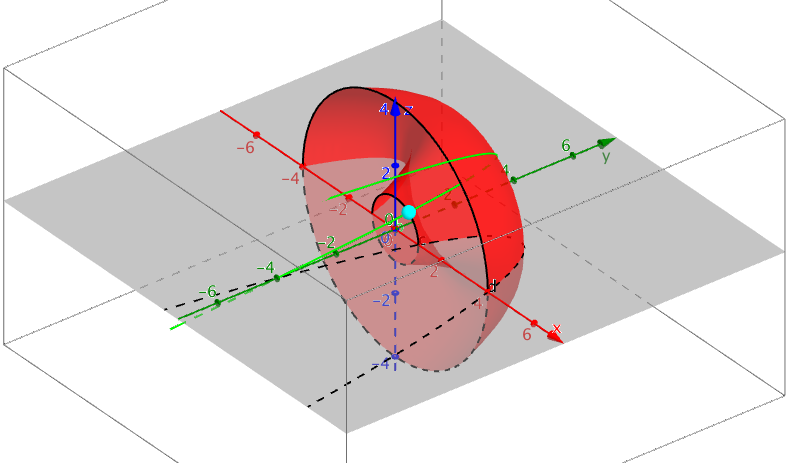
Surface Formed by Rotating a Parabola Around the y-Axis
Loading the math board and drawing, please wait…
In collections
BC Calculus
This example demonstrates the surface formed by rotating the part of the function f(x)=-(x-1)(x-4) above the x-axis around the y-axis. Key mathematical concepts include functions, solid geometry, and coordinate geometry. It uses commands like CurveCartesian, Surface, and Point in GeoGebra. Suitable for high school mathematics education and learning.
GeoGebra Commands & Parameters
Surface((u * cos(v)), f(u), (u * sin(v)), u, 1, 4, v, 0, 6.28319) → aCircle(yAxis, (1, 0, 0)) → cPoint(c) → ACurveCartesian((t * cos(acos(x(A)))), f(t), (t * sin(asin(z(A)))), t, -1, 6) → bCircle(yAxis, (4, 0, 0)) → d
AI Drawing Prompt Reference
Draw a surface formed by rotating the part of the function f(x)=-(x-1)(x-4) above the x-axis around the y-axis, showing the y-axis and two circles passing through points (1,0,0) and (4,0,0), and a curve connecting these circles to illustrate the cross-section of the rotating paraboloid.
The prompt above was compiled from the original drawing commands and is for reference only.