
Surface Area and Volume of Prisms and Cylinders by Mr. Reilly (2)
Loading the math board and drawing, please wait…
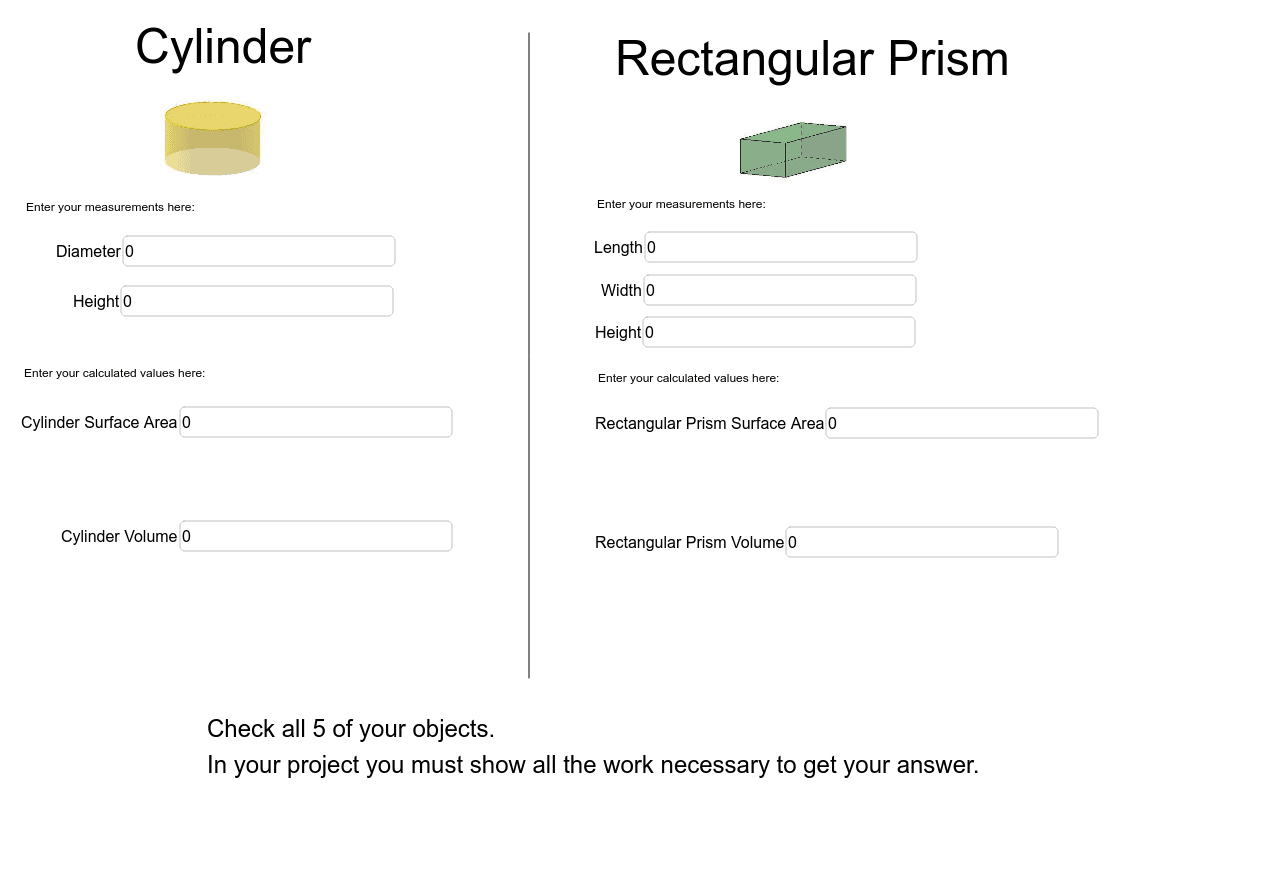
This GeoGebra example provides an interactive exploration of the surface area and volume of prisms and cylinders. It visually demonstrates how the total surface area (sum of lateral and base areas) and volume are calculated for these 3D solids, with a focus on rectangular prisms and circular cylinders. The core mathematical concepts involve solid geometry formulas, including lateral surface area, total surface area, and volume, as well as the relationship between dimensions (length, width, height, radius) and these measurements. The construction uses multiple Textfield and inputBox objects to let users input parameters such as length (L), width (W), and height (H), while Segment commands help build the geometric framework. Text objects (text1, text2, etc.) dynamically display computed values like lateral surface area (CSA), volume (CV), and other related quantities. This resource is ideal for middle and high school students learning solid geometry, enabling them to verify formulas, observe how changes in dimensions affect surface area and volume, and support classroom demonstrations or independent practice.
GeoGebra Commands & Parameters
Textfield(D) → inputBox1Textfield(CH) → inputBox2Textfield() → inputBox3Textfield(CV) → inputBox4Textfield(CSA) → inputBox5Textfield() → inputBox6Textfield() → inputBox7Textfield() → inputBox8Textfield() → inputBox9Textfield() → inputBox10Textfield(L) → inputBox11Textfield(W) → inputBox12Textfield(H) → inputBox13Textfield(PSA) → inputBox14Textfield(PV) → inputBox15Segment(K, M) → a
AI Drawing Prompt Reference
Create an interactive diagram for the surface area and volume of a rectangular prism and a cylinder. Start by adding input boxes for the user to enter length L, width W, and height H, then calculate and display the lateral surface area CSA, volume CV, total surface area PSA for the rectangular prism, and the lateral surface area CSA, volume CV for the cylinder. Draw the geometric framework of the prism and cylinder, use segment commands to connect key points, and dynamically show the calculated results.
The prompt above was compiled from the original drawing commands and is for reference only.