
Summing Line Segments: Ellipse Perimeter and Stochastic Process Visualization
Loading the math board and drawing, please wait…
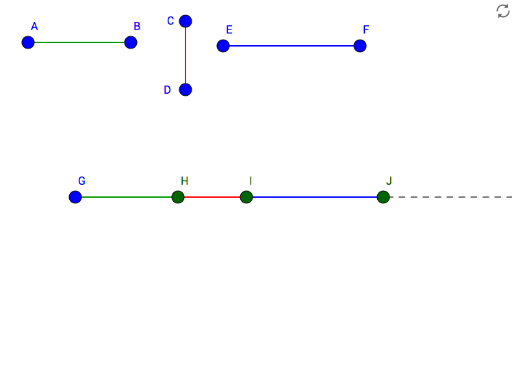
① This GeoGebra example demonstrates how multiple line segments can be summed end-to-end to approximate or represent the perimeter of an ellipse, while also visualizing stochastic processes and rotation. ② Core mathematical concepts include line segment summation, ellipse perimeter approximation, stochastic processes (e.g., random walks) simulated geometrically, rotation, and intersections of lines. ③ Construction highlights: using GeoGebra commands Segment, Ray, Circle, and Intersect; objects include points and lines A, B, f, C, D, g, E, F, h, G, step control objects step0 through step5 and wellDone, plus auxiliary elements L, zRay, c, H, d, I, e, J, zSegment, i, j, k. The construction builds stepwise accumulation of segment lengths to illustrate the summing process. ④ Suitable for high school to undergraduate mathematics, especially for analytic geometry, introductory calculus, or probability/statistics demonstrations of stochastic processes, and for exploring approximate methods for ellipse perimeter.
GeoGebra Commands & Parameters
Segment(A, B) → fSegment(C, D) → gSegment(E, F) → hRay(G, L) → zRayCircle(G, Segment[A, B]) → cIntersect(c, zRay, 1) → HCircle(H, Segment[C, D]) → dIntersect(d, zRay, 2) → ICircle(I, Segment[E, F]) → eIntersect(e, zRay, 2) → JSegment(G, J) → zSegmentSegment(G, H) → iSegment(H, I) → jSegment(I, J) → k