
Sum of Vectors and Geometric Interpretation
Loading the math board and drawing, please wait…
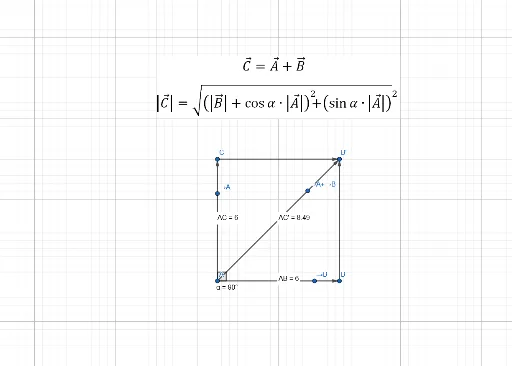
This example demonstrates the geometric representation of vector addition using GeoGebra. It constructs vectors A, B, and their sum u, illustrating the parallelogram law of vector addition. Key mathematical concepts include vector addition, geometric transformations, and coordinate representation. Construction involves using commands like Vector, Translate, Point, Distance, and Angle with objects A, B, u, C, v, etc. Suitable for high school students learning vector operations and analytic geometry, useful for teaching and self-study.
GeoGebra Commands & Parameters
Vector(A, B) → uVector(A, C) → vTranslate(C, u) → C'Vector(C, C') → wTranslate(B, v) → B'Vector(B, B') → aVector(A, C') → bPoint(v) → EPoint(u) → GDistance(A, C) → distanceACDistance(A, B) → distanceABPoint(b) → DDistance(A, C') → distanceAC'Angle(u, v) → α
AI Drawing Prompt Reference
Draw a graphic representing vector addition. Construct vectors A and B, and their sum vector u. Show the parallelogram law by forming vector v from points A and C, and using translations to get points C' and B'. Connect these points, mark distances and angles to illustrate vector relationships.
The prompt above was compiled from the original drawing commands and is for reference only.