
Sum of the First n Odd Numbers Geometric Proof
Loading the math board and drawing, please wait…
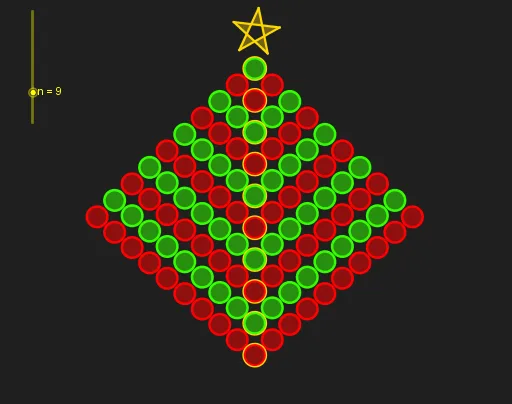
This example demonstrates the sum of the first n odd numbers as n squared through geometric shapes. It involves sequences and geometric construction. Commands like Sequence, Mirror, and Polygon are used to construct multiple geometric objects. Suitable for middle school and above students to learn the geometric proof method of the sum of odd numbers.
GeoGebra Commands & Parameters
Sequence(Rotate[Sequence[Circle[(j, (-k) - (f(a) * k)), r], j, 1, k, 1], (a * 45°), (0, (-k) - (f(a) * k))], k, 1, n) → l3Mirror(l3, yAxis) → l3'Sequence(Circle[(0, (-k) - (f(a) * k)), r], k, 0, n, 2) → tr1Sequence(Circle[(0, (-k) - (f(a) * k)), r], k, 1, n, 2) → tr2Sequence(Rotate[Sequence[Circle[(j, (-k) - (f(a) * k)), r], j, 1, k, 1], (a * 45°), (0, (-k) - (f(a) * k))], k, 1, n, 2) → li2Sequence(Rotate[Sequence[Circle[(j, (-k) - (f(a) * k)), r], j, 1, k, 1], (a * 45°), (0, (-k) - (f(a) * k))], k, 2, n, 2) → li1Mirror(li1, yAxis) → li1'Mirror(li2, yAxis) → li2'Sequence(Circle[(0, (-k) - (f(a) * k)), 0.5], k, 0, n, 1) → l2Polygon(A, B, 5) → poly1, h, i, j, k, l, C, D, EPolygon(A, D, B, E, C) → poly2, a_1, d, b_1, e, c_1
AI Drawing Prompt Reference
Draw a geometric proof showing that the sum of the first n odd numbers equals n squared, using rotated and mirrored circles to build the shape. Start by creating a sequence of circles, then rotate and mirror them. Next, create two sequences of circles and rotate and mirror them. Finally, draw two pentagons to illustrate the geometric representation of the sum of odd numbers.
The prompt above was compiled from the original drawing commands and is for reference only.