
Sum of Integers 2
Loading the math board and drawing, please wait…
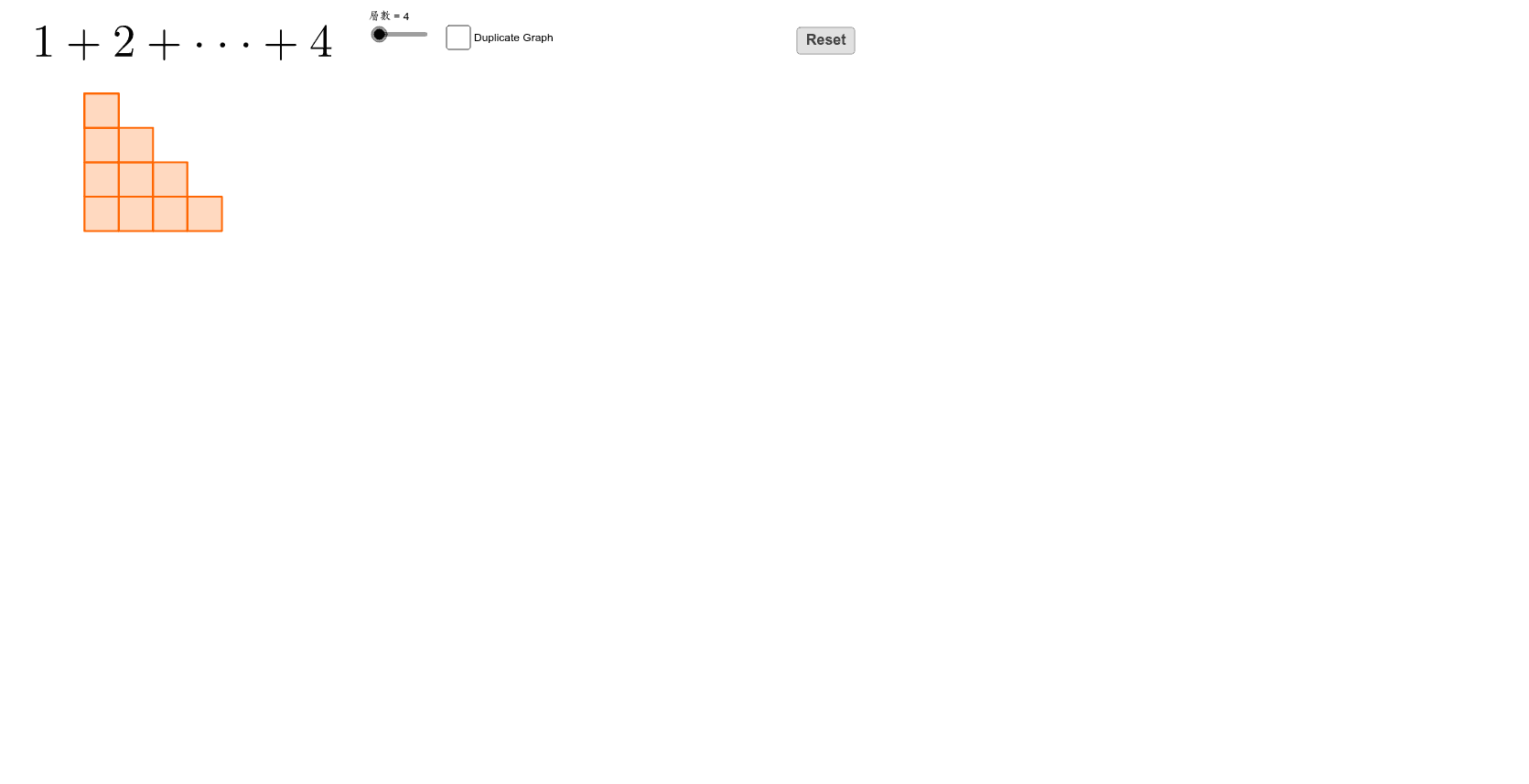
This example demonstrates the geometric representation of summing integers, involving core math concepts like integers, boxplots, quadratic equations, right triangles, upper and lower sums or Riemann sums, and rhombuses. It utilizes GeoGebra commands such as Polygon, Vector, Sequence, Segment, and Rotate. Suitable for high school mathematics education, helping students understand the relationship between integration and geometric figures.
GeoGebra Commands & Parameters
Polygon(A, B, 4) → poly1, f, g, h, i, C, DVector((0, 0), (1, 0)) → uVector((0, 0), (0, -1)) → vSequence(Translate[poly1, Vector[(k * v)]], k, 1, 層數 - 1) → list_{orange1}Sequence(Translate[poly1, Vector[(k * v) + u]], k, 1, 層數 - 1) → list_{orange2}Sequence(Translate[poly1, Vector[(k * v) + (2 * u)]], k, 2, 層數 - 1) → list_{orange3}Sequence(Translate[poly1, Vector[(k * v) + (3 * u)]], k, 3, 層數 - 1) → list_{orange4}Sequence(Translate[poly1, Vector[(k * v) + (4 * u)]], k, 4, 層數 - 1) → list_{orange5}Sequence(Translate[poly1, Vector[(k * v) + (5 * u)]], k, 5, 層數 - 1) → list_{orange6}Sequence(Translate[poly1, Vector[(k * v) + (6 * u)]], k, 6, 層數 - 1) → list_{orange7}Sequence(Translate[poly1, Vector[(k * v) + (7 * u)]], k, 7, 層數 - 1) → list_{orange8}Sequence(Translate[poly1, Vector[(k * v) + (8 * u)]], k, 8, 層數 - 1) → list_{orange9}Sequence(Translate[poly1, Vector[(k * v) + (9 * u)]], k, 9, 層數 - 1) → list_{orange10}Segment(E, F) → jSegment(G, H) → kSequence(Translate[poly1, Vector[((層數 + 1.5) * u) + (k * v)]], k, 1, 層數 - 1) → list_{blue2}Sequence(Translate[poly1, Vector[((層數 + 2.5) * u) + (k * v)]], k, 2, 層數 - 1) → list_{blue3}Sequence(Translate[poly1, Vector[((層數 + 3.5) * u) + (k * v)]], k, 3, 層數 - 1) → list_{blue4}Sequence(Translate[poly1, Vector[((層數 + 4.5) * u) + (k * v)]], k, 4, 層數 - 1) → list_{blue5}Sequence(Translate[poly1, Vector[((層數 + 5.5) * u) + (k * v)]], k, 5, 層數 - 1) → list_{blue6}Sequence(Translate[poly1, Vector[((層數 + 6.5) * u) + (k * v)]], k, 6, 層數 - 1) → list_{blue7}Sequence(Translate[poly1, Vector[((層數 + 7.5) * u) + (k * v)]], k, 7, 層數 - 1) → list_{blue8}Sequence(Translate[poly1, Vector[((層數 + 8.5) * u) + (k * v)]], k, 8, 層數 - 1) → list_{blue9}Sequence(Translate[poly1, Vector[((層數 + 9.5) * u) + (k * v)]], k, 9, 層數 - 1) → list_{blue10}Rotate(list_{blue2}, rotate, I) → Rotate_{b2}Rotate(list_{blue3}, rotate, I) → Rotate_{b3}Rotate(list_{blue4}, rotate, I) → Rotate_{b4}Rotate(list_{blue5}, rotate, I) → Rotate_{b5}Rotate(list_{blue6}, rotate, I) → Rotate_{b6}Rotate(list_{blue7}, rotate, I) → Rotate_{b7}Rotate(list_{blue8}, rotate, I) → Rotate_{b8}Rotate(list_{blue9}, rotate, I) → Rotate_{b9}Rotate(list_{blue10}, rotate, I) → Rotate_{b10}Sequence(Translate[poly1, Vector[((層數 + 0.5) * u) + (k * v)]], k, 0, 層數 - 1) → list_{blue1}