
Sum of Exterior Angles of Polygons - Dynamic Demonstration
Loading the math board and drawing, please wait…
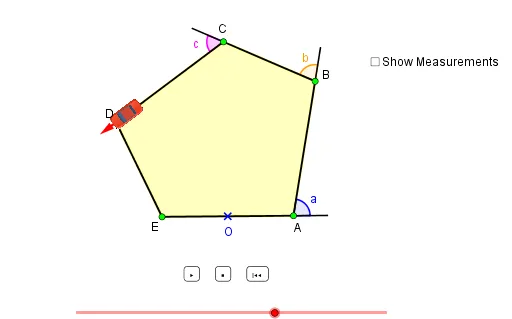
This GeoGebra example dynamically demonstrates the theorem that the sum of exterior angles of any polygon is always 360°. It visually shows how each exterior angle is formed by rotating one side to the next, and that the total rotation around the polygon equals one full turn. Core mathematical concepts include exterior angles, angle sum, rotation, and vector representation. The construction uses commands such as Polygon, Rotate, Vector, Angle, OrthogonalLine, Midpoint, Translate, and Segment to build the polygon and its exterior angles. Interactive sliders or draggable vertices allow users to change the polygon's shape while the sum remains constant. Suitable for middle school and above, this example is ideal for exploratory learning of polygon angle properties and for demonstrating geometric invariants in a classroom setting.
GeoGebra Commands & Parameters
Rotate((x(P1) + (x(A) - x(E)) / Distance[E, A], y(P1) + (y(A) - y(E)) / Distance[E, A]), (Min[Max[t - 1, 0], 1] * (180° - Angle[B, A, E])), P1) → P1'Rotate((x(P2) + (x(B) - x(A)) / Distance[A, B], y(P2) + (y(B) - y(A)) / Distance[A, B]), (Min[Max[t - 3, 0], 1] * (180° - Angle[C, B, A])), P2) → P2'Rotate((x(P3) + (x(C) - x(B)) / Distance[B, C], y(P3) + (y(C) - y(B)) / Distance[B, C]), (Min[Max[t - 5, 0], 1] * (180° - Angle[D, C, B])), P3) → P3'Rotate((x(P4) + (x(D) - x(C)) / Distance[C, D], y(P4) + (y(D) - y(C)) / Distance[C, D]), (Min[Max[t - 7, 0], 1] * (180° - Angle[E, D, C])), P4) → P4'Rotate((x(P5) + (x(E) - x(D)) / Distance[E, D], y(P5) + (y(E) - y(D)) / Distance[E, D]), (Min[Max[t - 9, 0], 1] * (180° - Angle[A, E, D])), P5) → P5'Polygon(E, A, B, C, D) → poly1, a_1, b_1, c_1, d_1, e_1If(t ≤ 2, P1, If[t ≤ 4, P2, If[t ≤ 6, P3, If[t ≤ 8, P4, If[t ≤ 10, P5, P6]]]]) → PIf(t ≤ 2, P1', If[t ≤ 4, P2', If[t ≤ 6, P3', If[t ≤ 8, P4', If[t ≤ 10, P5', P6']]]]) → P'Vector(P, P') → uAngle(P1', P1, (x(P1) + (x(A) - x(E)) / Distance[E, A], y(P1) + (y(A) - y(E)) / Distance[E, A])) → αAngle(P2', P2, (x(P2) + (x(B) - x(A)) / Distance[A, B], y(P2) + (y(B) - y(A)) / Distance[A, B])) → βAngle(P3', P3, (x(P3) + (x(C) - x(B)) / Distance[B, C], y(P3) + (y(C) - y(B)) / Distance[B, C])) → γAngle(P4', P4, (x(P4) + (x(D) - x(C)) / Distance[C, D], y(P4) + (y(D) - y(C)) / Distance[C, D])) → δAngle(P5', P5, (x(P5) + (x(E) - x(D)) / Distance[E, D], y(P5) + (y(E) - y(D)) / Distance[E, D])) → εOrthogonalLine(P, u) → fPoint(f) → FMidpoint(F, P') → GVector(G, P) → vTranslate(P, v) → P'_1Translate(P', v) → P''Segment(A, (x(A) + (x(A) - x(E)) / Distance[E, A], y(A) + (y(A) - y(E)) / Distance[E, A])) → gSegment(B, (x(B) + (x(B) - x(A)) / Distance[A, B], y(B) + (y(B) - y(A)) / Distance[A, B])) → hSegment(C, (x(C) + (x(C) - x(B)) / Distance[B, C], y(C) + (y(C) - y(B)) / Distance[B, C])) → iSegment(D, (x(D) + (x(D) - x(C)) / Distance[C, D], y(D) + (y(D) - y(C)) / Distance[C, D])) → jSegment(E, (x(E) + (x(E) - x(D)) / Distance[D, E], y(E) + (y(E) - y(D)) / Distance[D, E])) → kMidpoint(a_1) → OAngle((x(A) + (x(A) - x(E)) / Distance[E, A], y(A) + (y(A) - y(E)) / Distance[E, A]), A, B) → aAngle((x(B) + (x(B) - x(A)) / Distance[A, B], y(B) + (y(B) - y(A)) / Distance[A, B]), B, C) → bAngle((x(C) + (x(C) - x(B)) / Distance[B, C], y(C) + (y(C) - y(B)) / Distance[B, C]), C, D) → cAngle((x(D) + (x(D) - x(C)) / Distance[C, D], y(D) + (y(D) - y(C)) / Distance[C, D]), D, E) → dAngle((x(E) + (x(E) - x(D)) / Distance[D, E], y(E) + (y(E) - y(D)) / Distance[D, E]), E, A) → eIf((t ≥ 1) ∧ (t < 2), α, If[t ≥ 2, a, 0°]) → α'If((t ≥ 3) ∧ (t < 4), β, If[t ≥ 4, b, 0°]) → β'If((t ≥ 5) ∧ (t < 6), γ, If[t ≥ 6, c, 0°]) → γ'If((t ≥ 7) ∧ (t < 8), δ, If[t ≥ 7, d, 0°]) → δ'If((t ≥ 9) ∧ (t < 10), ε, If[t ≥ 9, e, 0°]) → ε'