
Sum of Exterior Angles of a Polygon by Jalen Raymond
Loading the math board and drawing, please wait…
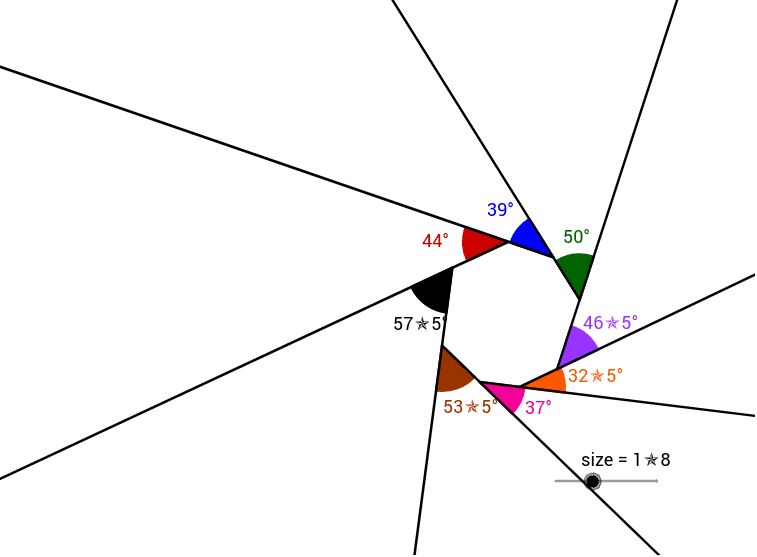
This example demonstrates the geometric phenomenon that the sum of exterior angles of any polygon is always 360°. Key math concepts involved include polygons, exterior angles, angles, and geometric transformations. Construction highlights involve using GeoGebra commands and objects such as Translate, Rotate, Circle, Ray, and Angle to build polygons and their exterior angles. Suitable for middle school and above students to learn basic properties of polygons and for teaching geometric transformations.
GeoGebra Commands & Parameters
Translate(A, Vector[(0, 0), (0, size)]) → A'Rotate(A', 50°, A) → A''Rotate(A'', 65°, A) → A'''Rotate(A''', 42°, A) → BRotate(B, 32°, A) → B'Rotate(B', 33°, A) → B''Circle(A, size) → cRay(A', A'') → aRay(A'', A''') → bRay(A''', B) → dRay(B, B') → eRay(B', B'') → fAngle(a, b) → βAngle(b, d) → γAngle(d, e) → δAngle(e, f) → εRotate(B'', 60°, A) → B'''Rotate(B''', 40°, A) → CRay(B'', B''') → gRay(B''', C) → hRay(C, A') → iAngle(f, g) → ζAngle(g, h) → ηAngle(h, i) → θAngle(i, a) → ι