
Sum of Exterior Angles of a Nonagon
Loading the math board and drawing, please wait…
In collections
Polygons Exterior Angle sum
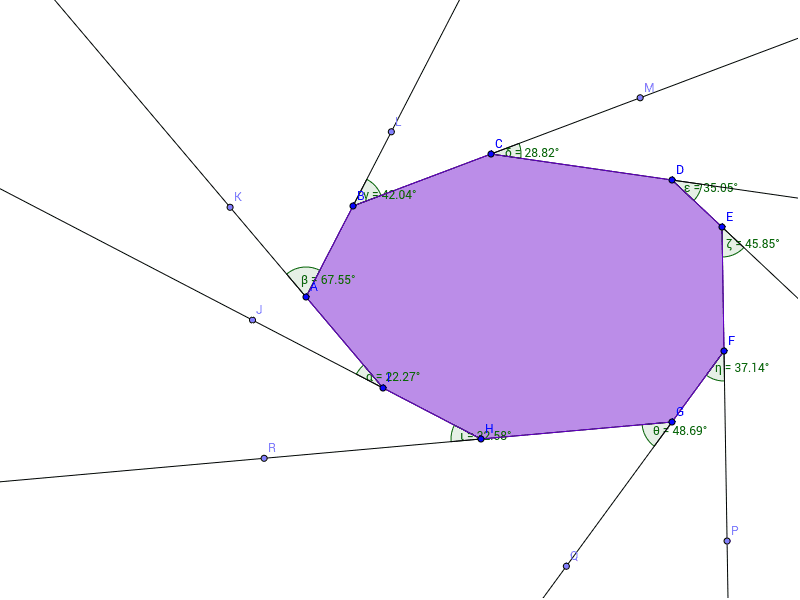
This example demonstrates the calculation and verification of the sum of exterior angles in a regular nonagon. Key math concepts include properties of exterior angles, the sum of interior angles theorem, and angle measurement. Constructed using GeoGebra commands like Ray, Polygon, Point, and Angle. Suitable for middle school and above students exploring polygon angle formulas.
GeoGebra Commands & Parameters
Ray(A, B) → aRay(B, C) → bRay(C, D) → cRay(D, E) → dRay(E, F) → eRay(F, G) → fRay(G, H) → gRay(H, I) → hRay(I, A) → iPolygon(I, A, B, C, D, E, F, G, H) → poly1, i_1, a_1, b_1, c_1, d_1, e_1, f_1, g_1, h_1Point(h) → JPoint(i) → KPoint(a) → LPoint(b) → MPoint(c) → NPoint(d) → OPoint(e) → PPoint(f) → QPoint(g) → RAngle(A, I, J) → αAngle(B, A, K) → βAngle(C, B, L) → γAngle(D, C, M) → δAngle(E, D, N) → εAngle(F, E, O) → ζAngle(G, F, P) → ηAngle(H, G, Q) → θAngle(I, H, R) → ι
AI Drawing Prompt Reference
Draw a regular nonagon and extend rays from each vertex to form exterior angles. Measure and label the angles. Verify that the sum of all exterior angles equals 360 degrees to demonstrate the property of the sum of exterior angles in a nonagon.
The prompt above was compiled from the original drawing commands and is for reference only.