
Step 5 Geometry Construction
Loading the math board and drawing, please wait…
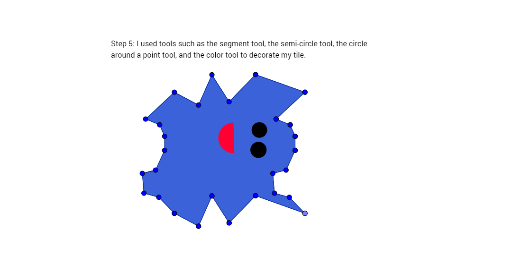
This example demonstrates the construction of geometric figures like pyramids, parallelograms, and tangent lines using GeoGebra. It involves core concepts such as polygon construction, vector operations, tangent line determination, perimeter calculation, and square properties. Key GeoGebra commands and objects used include Segment, OrthogonalLine, Point, Intersect, Vector, Translate, Polygon, Circle, and Semicircle. Suitable for high school mathematics education, helping students understand the connection between spatial and planar geometry.
GeoGebra Commands & Parameters
Segment(A, B) → fOrthogonalLine(A, f) → gOrthogonalLine(B, f) → hPoint(g) → COrthogonalLine(C, g) → iIntersect(h, i) → DSegment(A, B) → jSegment(A, C) → kSegment(C, D) → lSegment(B, D) → mSegment(A, E) → nSegment(F, E) → pSegment(F, G) → qSegment(H, G) → rSegment(H, B) → sVector(A, C) → uTranslate(A, u) → A'Translate(E, u) → E'Segment(A', E') → n'Translate(F, u) → F'Translate(E, u) → E'_1Segment(F', E'_1) → p'Translate(F, u) → F'_1Translate(G, u) → G'Segment(F'_1, G') → q'Translate(H, u) → H'Translate(G, u) → G'_1Segment(H', G'_1) → r'Translate(H, u) → H'_1Translate(B, u) → B'Segment(H'_1, B') → s'Segment(A, I) → tSegment(I, J) → aSegment(J, K) → bSegment(K, L) → cSegment(L, M) → dSegment(N, O) → eSegment(P, C) → f_1Vector(A, B) → vTranslate(A, v) → A'_1Translate(I, v) → I'Segment(A'_1, I') → t'Translate(I, v) → I'_1Translate(J, v) → J'Segment(I'_1, J') → a'Translate(J, v) → J'_1Translate(K, v) → K'Segment(J'_1, K') → b'Translate(K, v) → K'_1Translate(L, v) → L'Segment(K'_1, L') → c'Translate(L, v) → L'_1Translate(M, v) → M'Segment(L'_1, M') → d'Translate(N, v) → N'Translate(O, v) → O'Segment(N', O') → e'Translate(P, v) → P'Translate(C, v) → C'Segment(P', C') → g_1Segment(M, N) → h_1Segment(M, N) → i_1Segment(O, P) → j_1Segment(M, N) → k_1Segment(M', N') → l_1Segment(P', O') → m_1Polygon(F, E, P, C, E', F', G', H', D, P', O', N', A, M', L', K', J', I', B, H, G, I, J, K, L, M, N, O) → poly1, f_2, o, p_1, c_1, e'_1, f', g', h', d_1, p'_1, o', e_1, n'_1, m', l', k', j', i', b_1, h_2, g_2, a_1, i_2, j_2, k_2, l_2, m_2, n_1Circle(Q, S) → q_1Circle(R, T) → r_1Semicircle(U, V) → s_1Segment(V, U) → t_1Segment(V, U) → n_{2}