
Steiner Chain on Sphere
Loading the math board and drawing, please wait…
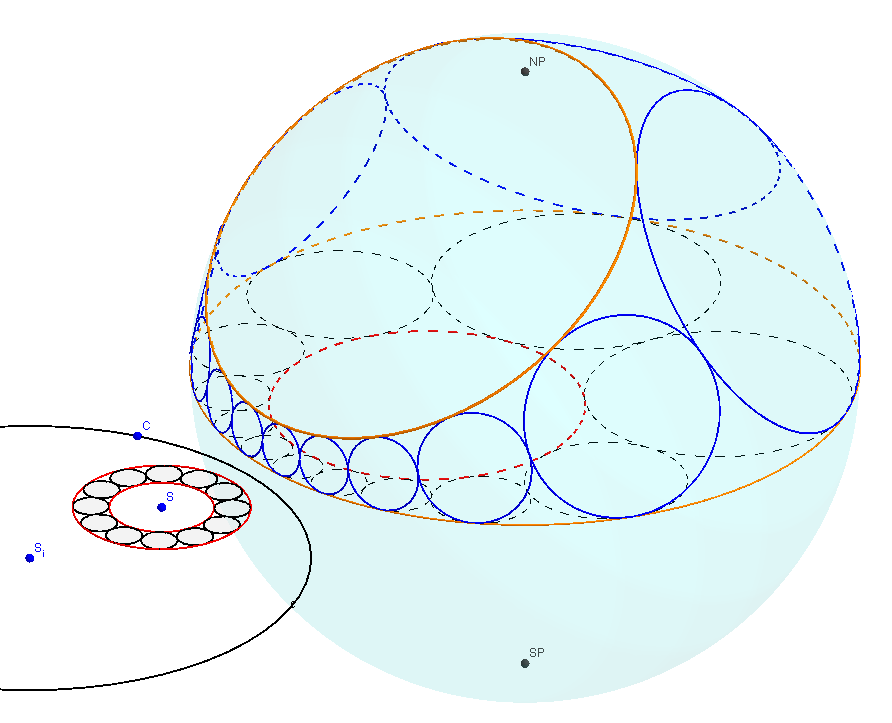
This example demonstrates the geometric construction of a Steiner chain on a sphere. It involves core mathematical concepts such as spherical geometry, equilateral triangles, rotation, and reflection. Key GeoGebra commands and objects used include Ray, Circle, Point, Rotate, If, Mirror, Sphere, Line, and Intersect. Suitable for high school and above students to explore the intersection of spherical geometry and geometric constructions.
GeoGebra Commands & Parameters
Ray(S_i, Vector[(0, 1)]) → bCircle(S, a) → k0Point(k0, t) → ACircle(S, B2) → k1Circle(S, B4) → k2Circle(Intersect[k2, Segment[S, A]], B3) → l0Rotate(l0, (C1 * (2 * π / n)), S) → D1Rotate(l0, (C2 * (2 * π / n)), S) → D2Rotate(l0, (C3 * (2 * π / n)), S) → D3Rotate(l0, (C4 * (2 * π / n)), S) → D4Rotate(l0, (C5 * (2 * π / n)), S) → D5Rotate(l0, (C6 * (2 * π / n)), S) → D6Rotate(l0, (C7 * (2 * π / n)), S) → D7Rotate(l0, (C8 * (2 * π / n)), S) → D8Rotate(l0, (C9 * (2 * π / n)), S) → D9Rotate(l0, (C10 * (2 * π / n)), S) → D10Rotate(l0, (C11 * (2 * π / n)), S) → D11Rotate(l0, (C12 * (2 * π / n)), S) → D12Rotate(l0, (C13 * (2 * π / n)), S) → D13Rotate(l0, (C14 * (2 * π / n)), S) → D14Rotate(l0, (C15 * (2 * π / n)), S) → D15Rotate(l0, (C16 * (2 * π / n)), S) → D16Rotate(l0, (C17 * (2 * π / n)), S) → D17Rotate(l0, (C18 * (2 * π / n)), S) → D18Rotate(l0, (C19 * (2 * π / n)), S) → D19Rotate(l0, (C20 * (2 * π / n)), S) → D20If(n - 1 ≥ C1, true, false) → E1If(n - 1 ≥ C2, true, false) → E2If(n - 1 ≥ C3, true, false) → E3If(n - 1 ≥ C4, true, false) → E4If(n - 1 ≥ C5, true, false) → E5If(n - 1 ≥ C6, true, false) → E6If(n - 1 ≥ C7, true, false) → E7If(n - 1 ≥ C8, true, false) → E8If(n - 1 ≥ C9, true, false) → E9If(n - 1 ≥ C10, true, false) → E10If(n - 1 ≥ C11, true, false) → E11If(n - 1 ≥ C12, true, false) → E12If(n - 1 ≥ C13, true, false) → E13If(n - 1 ≥ C14, true, false) → E14If(n - 1 ≥ C15, true, false) → E15If(n - 1 ≥ C16, true, false) → E16If(n - 1 ≥ C17, true, false) → E17If(n - 1 ≥ C18, true, false) → E18If(n - 1 ≥ C19, true, false) → E19If(n - 1 ≥ C20, true, false) → E20Point(b) → CCircle(S_i, C) → cMirror(D1, c) → F1Mirror(D2, c) → F2Mirror(D3, c) → F3Mirror(D4, c) → F4Mirror(D5, c) → F5Mirror(D6, c) → F6Mirror(D7, c) → F7Mirror(D8, c) → F8Mirror(D9, c) → F9Mirror(D10, c) → F10Mirror(D11, c) → F11Mirror(D12, c) → F12Mirror(D13, c) → F13Mirror(D14, c) → F14Mirror(D15, c) → F15Mirror(D16, c) → F16Mirror(D17, c) → F17Mirror(D18, c) → F18Mirror(D19, c) → F19Mirror(D20, c) → F20Mirror(k0, c) → k0'Mirror(k1, c) → k1'Sphere(Center[k0'], Radius[k0']) → dLine(Center[d], zAxis) → eIntersect(e, d) → SP, NPPoint(F1, 0) → G1Point(F1, 0.3333333333333333) → H1Point(F1, 0.6666666666666666) → I1Point(F2, 0) → G2Point(F2, 0.333333333333334) → H2Point(F2, 0.666666666666668) → I2Point(F3, 0) → G3Point(F3, 0.333333333333334) → H3Point(F3, 0.666666666666668) → I3Point(F4, 0) → G4Point(F4, 0.333333333333334) → H4Point(F4, 0.666666666666668) → I4Point(F5, 0) → G5Point(F5, 0.333333333333334) → H5Point(F5, 0.666666666666668) → I5Point(F6, 0) → G6Point(F6, 0.333333333333334) → H6Point(F6, 0.666666666666668) → I6Point(F7, 0) → G7Point(F7, 0.333333333333334) → H7Point(F7, 0.666666666666668) → I7Point(F8, 0) → G8Point(F8, 0.333333333333334) → H8Point(F8, 0.666666666666668) → I8Point(F9, 0) → G9Point(F9, 0.333333333333334) → H9Point(F9, 0.666666666666668) → I9Point(F10, 0) → G10Point(F10, 0.333333333333334) → H10Point(F10, 0.666666666666668) → I10Point(F11, 0) → G11Point(F11, 0.333333333333334) → H11Point(F11, 0.666666666666668) → I11Point(F12, 0) → G12Point(F12, 0.333333333333334) → H12Point(F12, 0.666666666666668) → I12Point(F13, 0) → G13Point(F13, 0.333333333333334) → H13Point(F13, 0.666666666666668) → I13Point(F14, 0) → G14Point(F14, 0.333333333333334) → H14Point(F14, 0.666666666666668) → I14Point(F15, 0) → G15Point(F15, 0.333333333333334) → H15Point(F15, 0.666666666666668) → I15Point(F16, 0) → G16Point(F16, 0.333333333333334) → H16Point(F16, 0.666666666666668) → I16Point(F17, 0) → G17Point(F17, 0.333333333333334) → H17Point(F17, 0.666666666666668) → I17Point(F18, 0) → G18Point(F18, 0.333333333333334) → H18Point(F18, 0.666666666666668) → I18Point(F19, 0) → G19Point(F19, 0.333333333333334) → H19Point(F19, 0.666666666666668) → I19Point(F20, 0) → G20Point(F20, 0.333333333333334) → H20Point(F20, 0.666666666666668) → I20Ray(SP, G1) → J1Ray(SP, H1) → K1Ray(SP, I1) → L1Ray(SP, G2) → J2Ray(SP, H2) → K2Ray(SP, I2) → L2Ray(SP, G3) → J3Ray(SP, H3) → K3Ray(SP, I3) → L3Ray(SP, G4) → J4Ray(SP, H4) → K4Ray(SP, I4) → L4Ray(SP, G5) → J5Ray(SP, H5) → K5Ray(SP, I5) → L5Ray(SP, G6) → J6Ray(SP, H6) → K6Ray(SP, I6) → L6Ray(SP, G7) → J7Ray(SP, H7) → K7Ray(SP, I7) → L7Ray(SP, G8) → J8Ray(SP, H8) → K8Ray(SP, I8) → L8Ray(SP, G9) → J9Ray(SP, H9) → K9Ray(SP, I9) → L9Ray(SP, G10) → J10Ray(SP, H10) → K10Ray(SP, I10) → L10Ray(SP, G11) → J11Ray(SP, H11) → K11Ray(SP, I11) → L11Ray(SP, G12) → J12Ray(SP, H12) → K12Ray(SP, I12) → L12Ray(SP, G13) → J13Ray(SP, H13) → K13Ray(SP, I13) → L13Ray(SP, G14) → J14Ray(SP, H14) → K14Ray(SP, I14) → L14Ray(SP, G15) → J15Ray(SP, H15) → K15Ray(SP, I15) → L15Ray(SP, G16) → J16Ray(SP, H16) → K16Ray(SP, I16) → L16Ray(SP, G17) → J17Ray(SP, H17) → K17Ray(SP, I17) → L17Ray(SP, G18) → J18Ray(SP, H18) → K18Ray(SP, I18) → L18Ray(SP, G19) → J19Ray(SP, H19) → K19Ray(SP, I19) → L19Ray(SP, G20) → J20Ray(SP, H20) → K20Ray(SP, I20) → L20Intersect(J1, d, 2) → M1Intersect(K1, d, 2) → N1Intersect(L1, d, 2) → O1Intersect(J2, d, 2) → M2Intersect(K2, d, 2) → N2Intersect(L2, d, 2) → O2Intersect(J3, d, 2) → M3Intersect(K3, d, 2) → N3Intersect(L3, d, 2) → O3Intersect(J4, d, 2) → M4Intersect(K4, d, 2) → N4Intersect(L4, d, 2) → O4Intersect(J5, d, 2) → M5Intersect(K5, d, 2) → N5Intersect(L5, d, 2) → O5Intersect(J6, d, 2) → M6Intersect(K6, d, 2) → N6Intersect(L6, d, 2) → O6Intersect(J7, d, 2) → M7Intersect(K7, d, 2) → N7Intersect(L7, d, 2) → O7Intersect(J8, d, 2) → M8Intersect(K8, d, 2) → N8Intersect(L8, d, 2) → O8Intersect(J9, d, 2) → M9Intersect(K9, d, 2) → N9Intersect(L9, d, 2) → O9Intersect(J10, d, 2) → M10Intersect(K10, d, 2) → N10Intersect(L10, d, 2) → O10Intersect(J11, d, 2) → M11Intersect(K11, d, 2) → N11Intersect(L11, d, 2) → O11Intersect(J12, d, 2) → M12Intersect(K12, d, 2) → N12Intersect(L12, d, 2) → O12Intersect(J13, d, 2) → M13Intersect(K13, d, 2) → N13Intersect(L13, d, 2) → O13Intersect(J14, d, 2) → M14Intersect(K14, d, 2) → N14Intersect(L14, d, 2) → O14Intersect(J15, d, 2) → M15Intersect(K15, d, 2) → N15Intersect(L15, d, 2) → O15Intersect(J16, d, 2) → M16Intersect(K16, d, 2) → N16Intersect(L16, d, 2) → O16Intersect(J17, d, 2) → M17Intersect(K17, d, 2) → N17Intersect(L17, d, 2) → O17Intersect(J18, d, 2) → M18Intersect(K18, d, 2) → N18Intersect(L18, d, 2) → O18Intersect(J19, d, 2) → M19Intersect(K19, d, 2) → N19Intersect(L19, d, 2) → O19Intersect(J20, d, 2) → M20Intersect(K20, d, 2) → N20Intersect(L20, d, 2) → O20Circle(M1, N1, O1) → P1Circle(M2, N2, O2) → P2Circle(M3, N3, O3) → P3Circle(M4, N4, O4) → P4Circle(M5, N5, O5) → P5Circle(M6, N6, O6) → P6Circle(M7, N7, O7) → P7Circle(M8, N8, O8) → P8Circle(M9, N9, O9) → P9Circle(M10, N10, O10) → P10Circle(M11, N11, O11) → P11Circle(M12, N12, O12) → P12Circle(M13, N13, O13) → P13Circle(M14, N14, O14) → P14Circle(M15, N15, O15) → P15Circle(M16, N16, O16) → P16Circle(M17, N17, O17) → P17Circle(M18, N18, O18) → P18Circle(M19, N19, O19) → P19Circle(M20, N20, O20) → P20Point(F21, 0) → G21Point(F21, 0.333333333333334) → H21Point(F21, 0.66666666666667) → I21Ray(SP, G21) → J21Ray(SP, H21) → K21Ray(SP, I21) → L21Intersect(J21, d, 2) → M21Intersect(K21, d, 2) → N21Intersect(L21, d, 2) → O21Circle(M21, N21, O21) → P21
AI Drawing Prompt Reference
On a sphere, draw a ray pointing upwards, then a circle centered at the sphere's center, and mark a point on this circle. Draw another circle centered at this point. Next, draw multiple circles centered at the sphere's center with varying radii, connecting one of these circles to the sphere's center and a point on the first circle. Finally, rotate and arrange these circles at specific angles to form a Steiner chain on the sphere.
The prompt above was compiled from the original drawing commands and is for reference only.