
Stars and Garters: Rotational Polygons and Probability Art
Loading the math board and drawing, please wait…
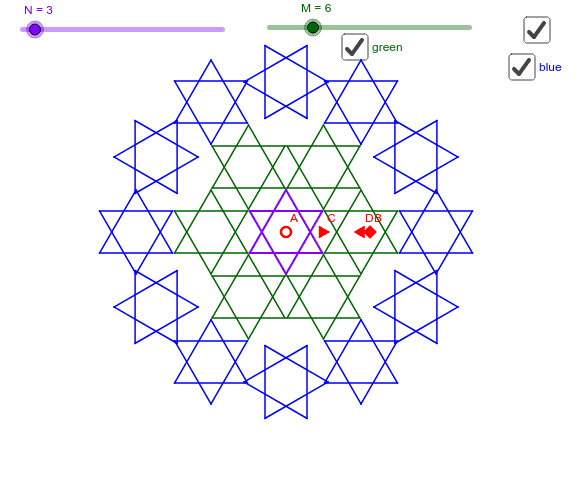
This GeoGebra example demonstrates a decorative geometric pattern inspired by Islamic art, featuring star-like shapes and garter-like bands formed through polygon rotation and sequences. The core mathematical concepts include polygons, rotation, sequences, probability, Pythagorean theorem, and special points. Construction uses GeoGebra commands such as Point, Segment, and Sequence to define points A, B, C, D, N, M, and generate lists list1, list2, list3, list4, which are then connected and rotated to create intricate star patterns. Suitable for middle school and above, this example is ideal for exploring geometric transformations, sequence patterns, and the interplay of probability in design. It serves both educational purposes in geometry classes and creative mathematical art projects.
GeoGebra Commands & Parameters
Point(Ray[A, A + (1, 0)]) → BPoint(Ray[A, B]) → CPoint(Ray[A, B]) → DSegment(A + A - C, C) → aSequence(Rotate[list1, ((i * 180) * ° / N), A], i, 1, N) → list3Sequence(Rotate[Translate[list3, Vector[A, D]], ((i * 360) * ° / M), A], i, 1, M) → list2Sequence(Rotate[Translate[list3, Vector[(2 * Vector[A, D])]], ((i * 180) * ° / M), A], i, 1, (2 * M)) → list4
AI Drawing Prompt Reference
Draw a star pattern composed of rotated polygons, including multiple rotated polygons and segments, forming a complex geometric design. Start by creating points A, B, C, and D on a line, then connect A and C to form segment a. Next, generate a rotation sequence by rotating polygons around point A N times, then translate and rotate these polygons M times along vector AD. Finally, rotate and translate these polygons again to form the final design.
The prompt above was compiled from the original drawing commands and is for reference only.