
Sierpinski Probability Tree: Fractal via Random Iteration by bildergairn
Loading the math board and drawing, please wait…
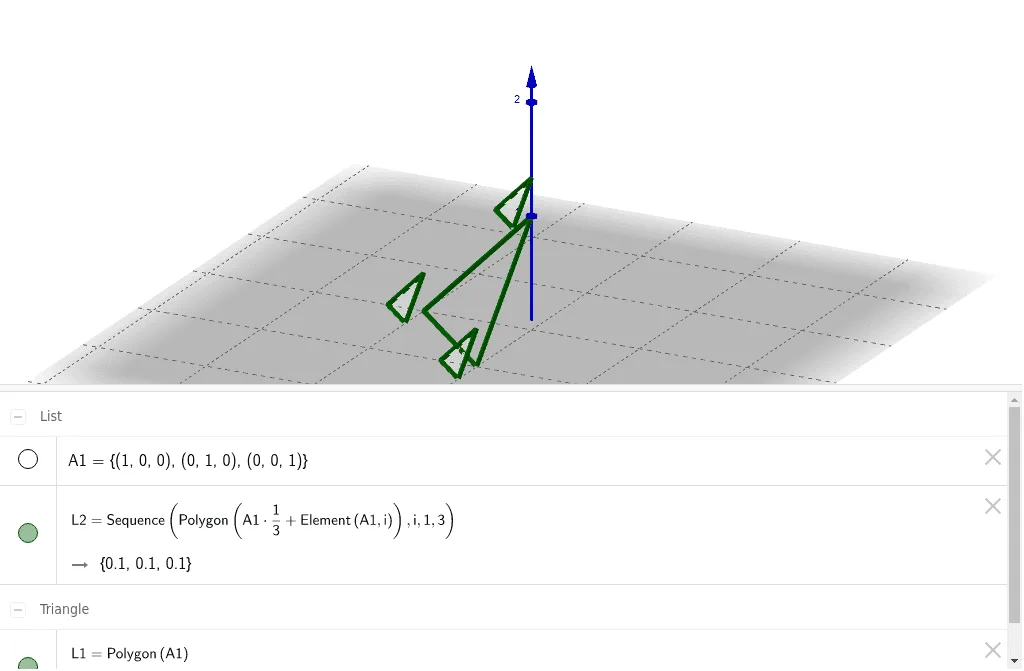
①This example demonstrates the classic Sierpinski triangle fractal generated by a probabilistic iterative process: starting from an initial polygon, repeatedly pick a random vertex and take the midpoint with the current point, eventually forming a self-similar triangular pattern with holes. ②Core mathematical concepts include probability and random variables, fractal geometry, iteration and limits, polygon construction, and the role of the circumcircle. ③Construction highlights: using GeoGebra commands Polygon and Sequence, the example creates an initial triangle (object A1), a list of vertices (L1), and a sequence of generated points (L2) where each new point is the midpoint between the previous point and a randomly chosen vertex)Skip. ④This is suitable for high school to undergraduate mathematics education, useful for teaching probability, fractals, or computational simulation, and helps students intuitively understand the connection between random processes and limiting geometric structures.
GeoGebra Commands & Parameters
Polygon(A1) → L1Sequence(Polygon[(A1 * 1 / 3) + Element[A1, i]], i, 1, 3) → L2