
SSA Ambiguity Demonstration
Loading the math board and drawing, please wait…
In collections
Similarity and Congruence Year 8 Pedagogies in Practice
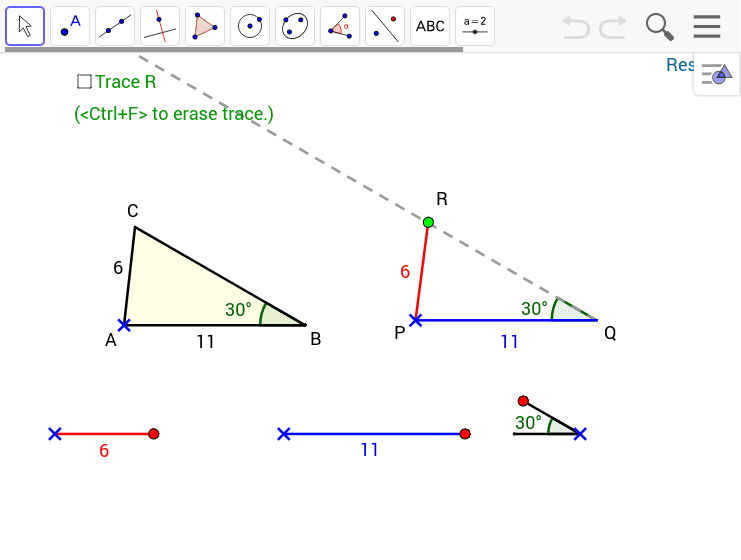
This example illustrates the ambiguity of constructing a triangle given two sides and a non-included angle (SSA). It involves core mathematical concepts such as trigonometry, circle theorems, and geometric constructions. The construction utilizes GeoGebra commands like Point, Rotate, Angle, Intersect, Polygon, Segment, Ray, and If. Suitable for high school mathematics education to understand the non-uniqueness of triangle construction and its practical applications.
GeoGebra Commands & Parameters
Point(Semicircle[(x(H) - 4, y(H)), (x(H) + 4, y(H))]) → JRotate(A, 330*°, B) → A'Angle(A', B, A) → αIntersect(Circle[A, 6], Line[B, A']) → C_1, CPolygon(A, B, C) → poly1, c, a, bPoint(Ray[D, (x(D) + 1, y(D))]) → ESegment(D, E) → dPoint(Ray[F, (x(F) + 1, y(F))]) → GSegment(F, G) → eAngle(J, H, I) → βRotate(P, -γ, Q) → P'Angle(P', Q, P) → δPoint(Circle[P, d]) → RRotate(I, -γ, H) → I'Angle(I', H, I) → εSegment(I, H) → gSegment(J, H) → hRay(Q, P') → iIntersect(OrthogonalLine[R, i], i) → KPolygon(P, Q, R) → poly2, r, p, qIf(Distance[R, K] < 0.01, true, false) → on
AI Drawing Prompt Reference
This is a diagram illustrating the ambiguity of constructing a triangle given two sides and a non-included angle. The figure includes a circle (labeled J), a triangle (poly1), and another triangle (poly2). Key objects are points A, B, C, P, Q, R, line segments d and e, ray i, angles α, β, δ, ε, and intersection point K. The construction order is: first draw circle J, then construct triangle poly1, next construct triangle poly2, and finally verify triangle existence through intersection point K between ray i and the perpendicular line from R. This diagram demonstrates the non-uniqueness of triangle construction under SSA conditions, suitable for mathematics education.
The prompt above was compiled from the original drawing commands and is for reference only.