
Squirrel's Acorn Stash: One Side of a Linear Equation
Loading the math board and drawing, please wait…
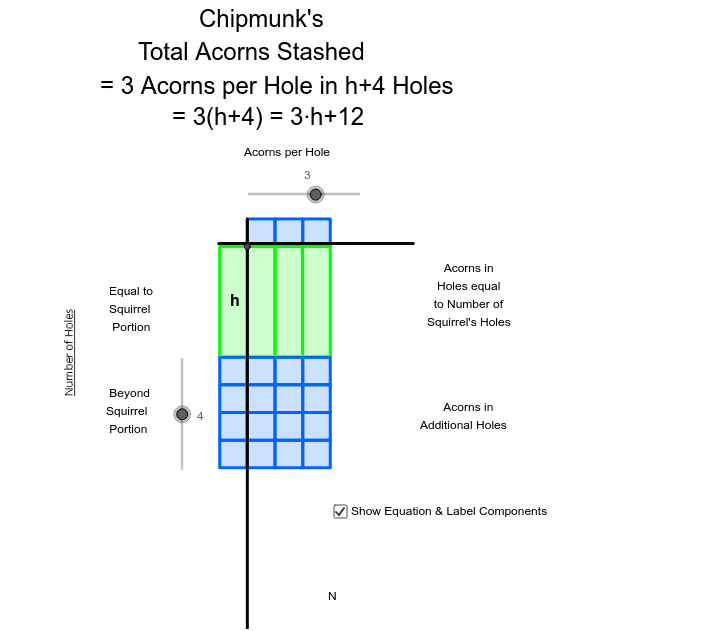
This example uses digital algebra tiles to help students find a part of one solution to a linear equation problem. It demonstrates how to solve linear equation problems using algebra tiles, involving core math concepts such as linear equations and algebra. The construction summary uses GeoGebra commands like Intersect, Point, Polygon, Vector, Translate, Sequence, and Segment. Suitable for middle school math education.
GeoGebra Commands & Parameters
Intersect(xAxis, yAxis) → APoint(xAxis) → BPoint(yAxis) → DPolygon(A, B, C, D) → poly1, a, b, c, dPoint(yAxis) → EVector(E, F) → uTranslate(A, u) → A'Translate(B, u) → B'Translate(C, u) → C'Translate(D, u) → D'Polygon(A', B', C', D') → poly1', a', b', c', d'Translate(A', u) → A''Translate(B', u) → B''Translate(C', u) → C''Translate(D', u) → D''Polygon(A'', B'', C'', D'') → poly1'', a'', b'', c'', d''Translate(A'', u) → A'''Translate(B'', u) → B'''Translate(C'', u) → C'''Translate(D'', u) → D'''Polygon(A''', B''', C''', D''') → poly1''', a''', b''', c''', d'''Translate(A''', v) → GTranslate(B''', v) → HTranslate(C''', v) → ITranslate(D''', v) → JTranslate(A''', u) → KTranslate(B''', u) → LTranslate(C''', u) → MTranslate(D''', u) → NPolygon(K, L, M, N) → poly2, k, l, m, nSequence(Polygon[(0, (-i)), (-1, (-i)), (-1, (-i) + 4), (0, (-i) + 4)], i, 4, (4 * num2), 4) → list2Sequence(Polygon[(0, ((-4) * num2) - j), (0, ((-4) * num2) - (j - 1)), 4], j, 1, con2, 1) → list3Sequence(Polygon[((4 * num) + j - 1, 0), ((4 * num) + j, 0), 4], j, 1, con1, 1) → list4Sequence(Sequence[Polygon[((4 * (n - 1)), ((-4) * m)), ((4 * n), ((-4) * m)), 4], m, 1, num2], n, 1, num) → list1Segment(P, Q) → eSegment(R, S) → fSequence(Sequence[Polygon[((4 * i), ((-4) * num2) - j), ((4 * i), ((-4) * num2) - j + 1), ((4 * (i - 1)), ((-4) * num2) - j + 1), ((4 * (i - 1)), ((-4) * num2) - j)], j, 1, con2], i, 1, num) → list6Sequence(Sequence[Polygon[((4 * num) + j - 1, ((-4) * (i - 1))), ((4 * num) + j, ((-4) * (i - 1))), ((4 * num) + j, ((-4) * i)), ((4 * num) + j - 1, ((-4) * i))], j, 1, con1], i, 1, num2) → list7Sequence(Sequence[Polygon[((4 * num) + j - 1, ((-4) * num2) - i), ((4 * num) + j, ((-4) * num2) - i), 4], j, 1, con1], i, 1, con2) → list5Polygon(T, U, V, W) → poly3, t, u_1, v_1, wPolygon(Z, A_1, B_1, C_1) → poly4, z, a_1, b_1, c_1Polygon(D_1, E_1, F_1, G_1) → poly5, d_1, e_1, f_1, g_1Polygon(H_1, I_1, J_1, K_1) → poly6, h_1, i_1, j_1, k_1