
Square Root Spiral Animation
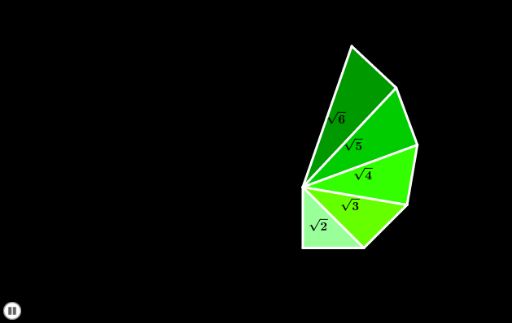
Loading the math board and drawing, please wait…
This example demonstrates the generation process of a square root spiral through animation, showing how a point moves as its distance from the origin increases by the square root. Key math concepts include square root functions, geometric constructions, coordinate geometry, and dynamic geometry. The construction utilizes GeoGebra commands and objects like Intersect, Circle, Segment, OrthogonalLine, and Polygon as outlined in the summary. It is suitable for high school and above students to understand dynamic function graphs and geometric construction techniques.
GeoGebra Commands & Parameters
Intersect(xAxis, yAxis) → BCircle(B, 1) → cIntersect(c, yAxis) → B_2, ZIntersect(c, xAxis) → D_2, CSegment(Z, B) → a_4Segment(B, C) → bSegment(Z, C) → dOrthogonalLine(C, d) → eCircle(C, 1) → fIntersect(f, e) → F_2, DSegment(Z, D) → gOrthogonalLine(D, g) → hCircle(D, 1) → kIntersect(k, h) → H_2, ESegment(C, D) → iSegment(D, E) → jSegment(Z, E) → lOrthogonalLine(E, l) → mCircle(E, 1) → pIntersect(p, m) → J_1, FSegment(E, F) → nSegment(Z, F) → qOrthogonalLine(F, q) → rCircle(F, 1) → sIntersect(s, r) → L_1, GSegment(F, G) → tSegment(Z, G) → a_1OrthogonalLine(G, a_1) → b_1Circle(G, 1) → c_1Intersect(c_1, b_1) → N_1, HSegment(Z, H) → d_1OrthogonalLine(H, d_1) → e_1Circle(H, 1) → f_1Intersect(f_1, e_1) → P_1, ISegment(Z, I) → g_1Segment(G, H) → h_1Segment(H, I) → i_1OrthogonalLine(I, g_1) → j_1Circle(I, 1) → k_1Intersect(k_1, j_1) → R, JSegment(I, J) → l_1Segment(J, Z) → m_1OrthogonalLine(J, m_1) → n_1Circle(J, 1) → p_1Intersect(p_1, n_1) → K, USegment(K, Z) → q_1Segment(J, K) → r_1OrthogonalLine(K, q_1) → s_1Circle(K, 1) → t_1Intersect(t_1, s_1) → L, WSegment(K, L) → a_2Segment(L, Z) → b_2OrthogonalLine(L, b_2) → c_2Circle(L, 1) → d_2Intersect(d_2, c_2) → M, A_1Segment(L, M) → e_2Segment(M, Z) → f_2OrthogonalLine(M, f_2) → g_2Circle(M, 1) → h_2Intersect(h_2, g_2) → N, C_1Segment(M, N) → i_2Segment(N, Z) → j_2OrthogonalLine(N, j_2) → k_2Circle(N, 1) → p_2Intersect(p_2, k_2) → O, E_1Segment(N, O) → l_2Segment(O, Z) → m_2OrthogonalLine(O, m_2) → n_2Circle(O, 1) → q_2Intersect(q_2, n_2) → P, G_1Segment(O, P) → r_2Segment(P, Z) → s_2OrthogonalLine(P, s_2) → t_2Circle(P, 1) → c_3Intersect(c_3, t_2) → Q, I_1Segment(P, Q) → a_3Segment(Q, Z) → b_3Polygon(B, C, Z) → poly1, z_1, b_4, c_4Polygon(C, D, Z) → poly2, z_2, c_5, d_3Polygon(D, E, Z) → poly3, z_3, d_4, e_3Polygon(E, F, Z) → poly4, z_4, e_4, f_3Polygon(F, G, Z) → poly5, z_5, f_4, g_3Polygon(G, H, Z) → poly6, z_6, g_4, h_3Polygon(H, I, Z) → poly7, z_7, h_4, i_3Polygon(I, J, Z) → poly8, z_8, i_4, j_3Polygon(J, K, Z) → poly9, z_9, j_4, k_3Polygon(K, L, Z) → poly10, z_{10}, k_4, l_3Polygon(L, M, Z) → poly11, z_{11}, l_4, m_3Polygon(M, N, Z) → poly12, z_{12}, m_4, n_3Polygon(N, O, Z) → poly13, z_{13}, n_4, oPolygon(O, P, Z) → poly14, z_{14}, o_1, p_3Polygon(P, Q, Z) → poly15, z_{15}, p_4, q_3