
Spiral Sofia S
Loading the math board and drawing, please wait…
In collections
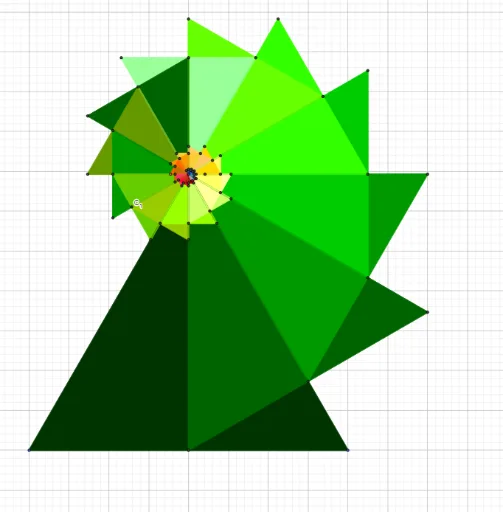
EQUILATERAL TRIANGLE SPIRAL
This example demonstrates the construction and properties of the Spiral Sofia S, involving hyperbolas, logarithmic functions, conic sections, and similar triangles. Key GeoGebra commands and objects used include Polygon, OrthogonalLine, and Intersect. Suitable for high school and above learners to understand complex geometric constructions and applications of related mathematical concepts.
GeoGebra Commands & Parameters
Polygon(A, B, 3) → poly1, f, g, h, COrthogonalLine(C, f) → iIntersect(i, f) → DPolygon(C, D, 3) → poly2, j, k, l, EOrthogonalLine(C, k) → mIntersect(m, k) → FPolygon(C, F, 3) → poly3, n, p, q, GOrthogonalLine(C, p) → rIntersect(r, p) → HPolygon(C, H, 3) → poly4, s, t, a, IOrthogonalLine(C, t) → bIntersect(b, t) → JPolygon(C, J, 3) → poly5, c, d, e, KOrthogonalLine(C, d) → f_1Intersect(f_1, d) → LPolygon(C, L, 3) → poly6, g_1, h_1, i_1, MOrthogonalLine(C, h_1) → j_1Intersect(j_1, h_1) → NPolygon(C, N, 3) → poly7, k_1, l_1, m_1, OIntersect(l_1, i) → PPolygon(C, P, 3) → poly8, n_1, p_1, q_1, QIntersect(m, m_1) → RIntersect(m, m_1) → SIntersect(m, m_1) → TIntersect(p_1, m) → UPolygon(C, U, 3) → poly9, r_1, s_1, t_1, VIntersect(s_1, r) → WPolygon(C, W, 3) → poly10, a_1, b_1, c_1, ZIntersect(b_1, b) → A_1Polygon(C, A_1, 3) → poly11, d_1, e_1, f_2, B_1Intersect(e_1, f_1) → C_1Polygon(C, C_1, 3) → poly12, g_2, h_2, i_2, D_1Intersect(j_1, h) → E_1Intersect(h_2, j_1) → F_1Polygon(C, F_1, 3) → poly13, j_2, k_2, l_2, G_1Intersect(k_2, i) → H_1Polygon(C, H_1, 3) → poly14, m_2, n_2, p_2, I_1Intersect(n_2, m) → J_1Polygon(C, J_1, 3) → poly15, q_2, r_2, s_2, K_1Intersect(r_2, r) → L_1Polygon(C, L_1, 3) → poly16, t_2, a_2, b_2, M_1Intersect(b, q) → N_1Intersect(a_2, b) → O_1Polygon(C, O_1, 3) → poly17, c_2, d_2, e_2, P_1Intersect(j_1, e) → Q_1Intersect(j_1, e) → R_1Intersect(f_1, a) → S_1Intersect(d_2, f_1) → T_1Polygon(C, T_1, 3) → poly18, f_3, g_3, h_3, U_1Intersect(i, i_1) → V_1Intersect(g_3, j_1) → W_1Polygon(C, W_1, 3) → poly19, i_3, j_3, k_3, Z_1Intersect(j_3, i) → A_2Polygon(C, A_2, 3) → poly20, l_3, m_3, n_3, B_2Intersect(m, m_1) → C_2Intersect(m_3, m) → D_2Polygon(C, D_2, 3) → poly21, p_3, q_3, r_3, E_2Intersect(q_3, r) → F_2Polygon(C, F_2, 3) → poly22, s_3, t_3, a_3, G_2Intersect(b, t_1) → H_2Intersect(t_3, b) → I_2Polygon(C, I_2, 3) → poly23, b_3, c_3, d_3, J_2Intersect(f_1, c_1) → K_2Intersect(c_3, f_1) → L_2Polygon(C, L_2, 3) → poly24, e_3, f_4, g_4, M_2Intersect(j_1, h) → N_2Intersect(j_1, h) → O_2Intersect(f_4, j_1) → P_2Polygon(C, P_2, 3) → poly25, h_4, i_4, j_4, Q_2Intersect(i, j) → R_2Intersect(i_4, i) → S_2Polygon(C, S_2, 3) → poly26, k_4, l_4, m_4, T_2Intersect(m, g) → U_2Intersect(l_4, m) → V_2Polygon(C, V_2, 3) → poly27, n_4, p_4, q_4, W_2Intersect(r, l) → Z_2Intersect(p_4, r) → A_3Polygon(C, A_3, 3) → poly28, r_4, s_4, t_4, B_3Intersect(s_4, b) → C_3Polygon(C, C_3, 3) → poly29, a_4, b_4, c_4, D_3Intersect(b_4, f_1) → E_3Polygon(C, E_3, 3) → poly30, d_4, e_4, f_5, F_3Intersect(j_1, e) → G_3Intersect(e_4, j_1) → H_3Polygon(C, H_3, 3) → poly31, g_5, h_5, i_5, I_3