
Spin Planes: Dynamic Symmetry with Rotated Polygons and Vectors
Loading the math board and drawing, please wait…
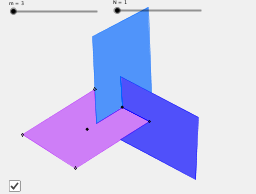
This GeoGebra example demonstrates a spinning plane-like pattern built from rotated polygons, segments, points, and vectors, producing a dynamic symmetric design inspired by mathematical art. It involves 3D vectors, rotation transformations, polygon construction, sequence generation, and spatial symmetry. The construction uses Segment and Point to create base elements, Vector to define directions and lengths, Rotate to turn points or figures around a center, Sequence to generate repeated lists such as list1, list2, list3, and list4, and Polygon to connect rotated points into closed shapes like poly1. It is suitable for high school or early college students studying vectors, transformations, coordinate geometry, and dynamic geometry, and can be used for classroom demonstrations, mathematical art projects, or explorations of symmetry and motion.
GeoGebra Commands & Parameters
Segment(A, B) → aSequence(Rotate[B, ((i * 360) * ° / m), A], i, 1, m) → list1Point(Segment[A, Element[list1, 1]]) → FVector(A, B) → uPoint(Ray[F, u]) → GRotate(F, (-360 * ° / m), A) → F'Rotate(G, (-360 * ° / m), A) → G'Segment(F', G') → bPoint(b) → EPoint(Ray[E, u]) → HPolygon(A, F, G, H, E, F') → poly1, a_1, f, g, h, e, f'Sequence(Polygon[Rotate[A, ((i * 360) * ° / m), A], Rotate[F, ((i * 360) * ° / m), A], Rotate[G, ((i * 360) * ° / m), A], Rotate[H, ((i * 360) * ° / m), A], Rotate[E, ((i * 360) * ° / m), A], Rotate[F', ((i * 360) * ° / m), A]], i, 1, m) → list2Sequence(Polygon[Dilate[G, (N - i) / N, F'], Dilate[H, (N - i) / N, F'], Dilate[E, (N - i) / N, F'], F', A, Dilate[F, (N - i) / N, A]], i, 0, N) → list3Rotate(list3, (360 * ° / m), A) → list3'Rotate(list3', (360 * ° / m), A) → list3''Rotate(list3'', (360 * ° / m), A) → list3'''Rotate(list3''', (360 * ° / m), A) → list4Rotate(list4, (360 * ° / m), A) → list4'Rotate(list4', (360 * ° / m), A) → list4''Rotate(list4'', (360 * ° / m), A) → list4'''
AI Drawing Prompt Reference
Draw a dynamic symmetric graphic composed of rotated polygons. Start by creating a line segment and two points. Then, use rotation transformations to rotate points around a center, generating a series of polygons. Next, apply scaling transformations to deform the polygons and rotate them again to create symmetry. Finally, connect all rotated and scaled polygons to form a complete graphic. Ensure the graphic has dynamic symmetry for mathematical art display.
The prompt above was compiled from the original drawing commands and is for reference only.