
Spherical Helix Speed Based on Height
Loading the math board and drawing, please wait…
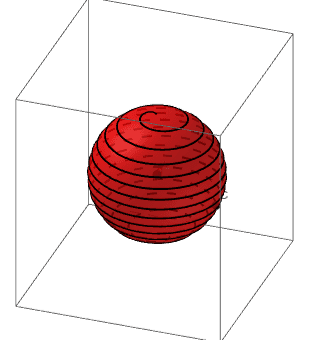
This example demonstrates the 3D trajectory of a spherical helix and its dynamic relationship between speed and height using parametric equations, trigonometric functions, and analytical geometry. Key mathematical concepts include parametric equations, trigonometry, coordinate geometry, and solid geometry. Constructed with GeoGebra commands like Intersect, Point, Sphere, and CurveCartesian, it is suitable for high school and above students to understand spatial curves and dynamic variations.
GeoGebra Commands & Parameters
Intersect(zAxis, xAxis) → APoint(zAxis) → BSphere(A, B) → cCurveCartesian((sin((40 * b)) * sqrt(1 - b^(2))), (cos((40 * b)) * sqrt(1 - b^(2))), b, b, -1, 1) → d
AI Drawing Prompt Reference
Draw a spherical helix where the height is controlled by parameter b and the speed is related to height. First, create point A at the intersection of the z-axis and x-axis, then construct a sphere c with A and a point B on the z-axis as its diameter. Next, use parametric equations to draw the helix d, with x-coordinate as sin(40b) times the square root of 1-b^2, y-coordinate as cos(40b) times the square root of 1-b^2, and z-coordinate as b, where b ranges from -1 to 1.
The prompt above was compiled from the original drawing commands and is for reference only.