
Sphere Volume Proof
Loading the math board and drawing, please wait…
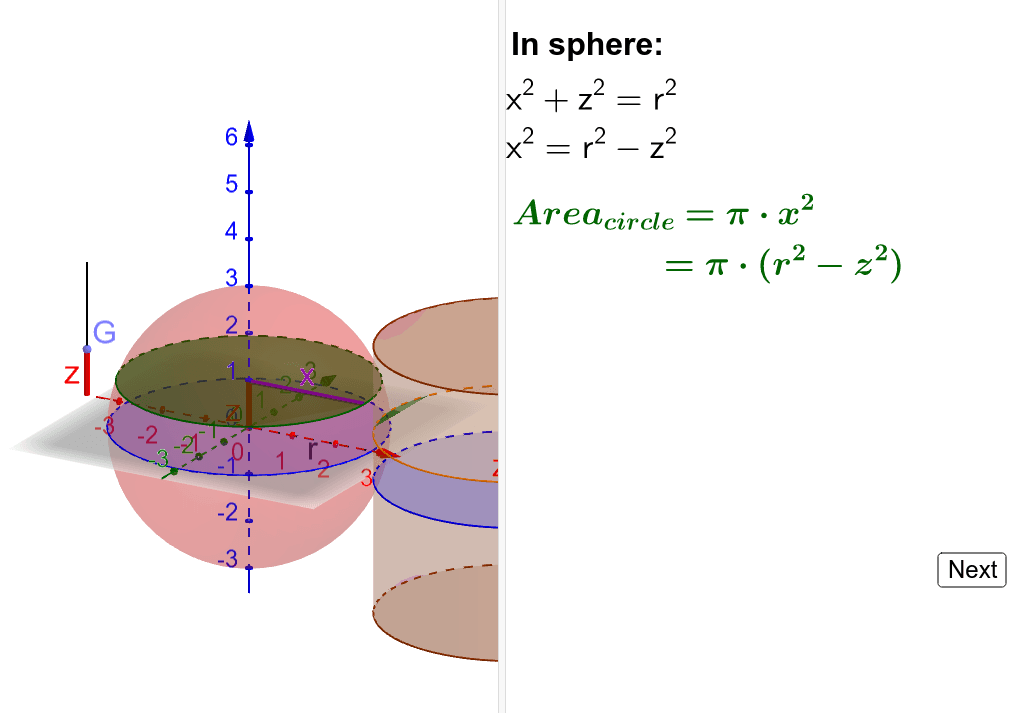
This example dynamically demonstrates and geometrically constructs the derivation of the sphere volume formula. It involves core mathematical concepts such as sphere, volume, similarity transformation, geometric construction, and orthogonal lines. GeoGebra commands and objects used include Intersect, Point, Circle, Distance, Sphere, Cylinder, OrthogonalLine, Segment, IntersectPath, Surface, Polygon, and If. Suitable for high school solid geometry teaching, helping students understand the geometric meaning and derivation logic of the volume formula.
GeoGebra Commands & Parameters
Intersect(xAxis, yAxis) → APoint(xAxis) → BCircle(A, B) → cDistance(A, B) → rPoint(xAxis) → DCircle(D, r) → hSphere(A, r) → aCylinder(h, r) → b, d, eCylinder(h, (-r)) → f, g, iPoint(xAxis) → COrthogonalLine(C, xOyPlane) → jSegment(E, C) → kPoint(k) → GIntersectPath(l, a) → pIntersectPath(l, b) → qSurface((u * cos(θ)) + Distance[A, D], (u * sin(θ)), u, θ, 0, 6.283185307179586, u, (-r), r) → mIntersectPath(l, f) → sOrthogonalLine(D, l) → nSurface(x(H) + (u * cos(θ)), (u * sin(θ)), z(G), u, z(G), r, θ, 0, 6.283185307179586) → oSegment(A, B) → tIntersect(h, xAxis, 2) → JSegment(D, J) → a_1Segment(A, I) → b_1Segment(D, H) → c_1Intersect(u, p) → K, LSegment(I, L) → d_1Segment(A, L) → e_1Segment(H, N) → f_1Segment(C, G) → g_1Segment(A, L) → h_1Polygon(A, I, L) → poly1, l_1, a_2, i_1Segment(S, R) → j_1Polygon(S, R, D) → poly2, d_2, s_1, r_1Segment(D, S) → k_1If(Step ≠ 10, Step ≟ Step + 1, Step ≟ 0) → vIf(Step ≠ 10, Step ≟ Step + 1, Step ≟ 0) → wIf(Step ≠ 10, Step ≟ Step + 1, Step ≟ 0) → m_1If(Step ≠ 10, Step ≟ Step + 1, Step ≟ 0) → n_1If(Step ≠ 10, Step ≟ Step + 1, Step ≟ 0) → o_1If(Step ≠ 10, Step ≟ Step + 1, Step ≟ 0) → p_1